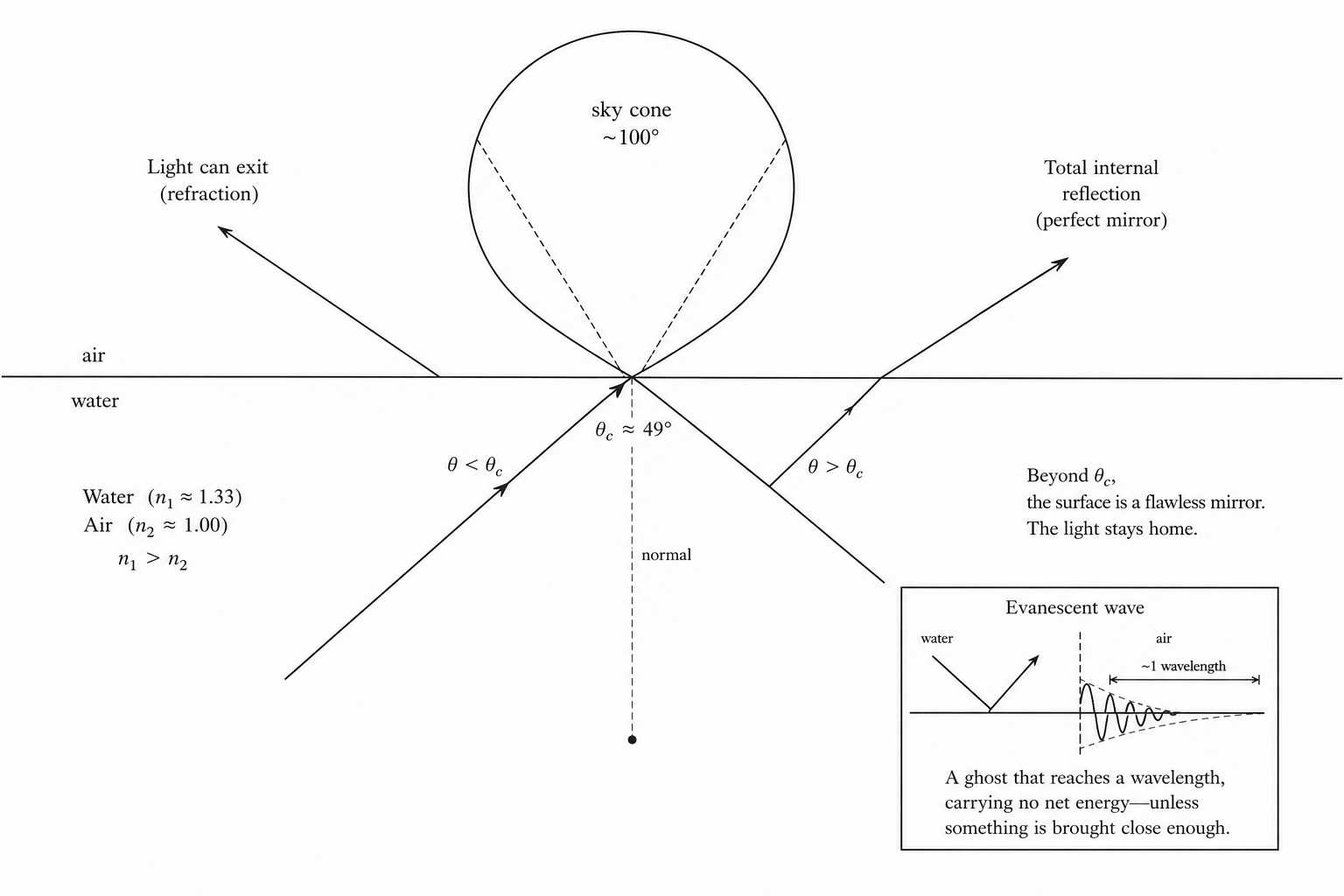
A diver who looks up from a depth of a few meters perceives a curious and instructive phenomenon. The entire sky is compressed into a single luminous circle directly overhead, the horizon bent inward, the sun and clouds and passing birds crowded into a cone scarcely a hundred degrees across. Beyond the rim of that circle, the surface ceases to function as a window and becomes, instead, a mirror, one that throws back at the diver the sand beneath him, the pale flash of his own fins, the reef at his back. The boundary between the disk and the mirror sits at a fixed angle, approximately forty-nine degrees from the vertical, and the physics that determines it is unremarkable. Light slows as it enters water and accelerates as it leaves; the bending that accompanies this change of speed grows steeper as the path to the surface grows shallow; and at one particular angle the departing ray lies flat along the surface itself. Beyond that angle, the light cannot leave the water at all. This phenomenon is known as total internal reflection, and it is necessary to emphasize at the outset that it involves no dimming, no attenuation, no partial loss. Past the critical angle, the surface is a flawless mirror, and the water retains the entirety of its own light.
I would argue that polemic is a mode of discourse that operates entirely past the critical angle. The unease I have long felt in the presence of polemical writing, an unease I was slow to name because I had mistaken it for ordinary disagreement with one conclusion or another, turns out on closer examination to be the recognition that the light was never intended to leave the water. Consider the structure of the genre. The refutation is ostensibly addressed to the very person it refutes. It is furnished with the full apparatus of address: the opponent’s position is quoted, numbered, and answered point by point, and the second person is at times made explicit, as though the answering might actually reach him. Yet the longer one reads, the more apparent it becomes that the geometry of the encounter has been arranged against any such reaching. The angle of approach has been selected, whether consciously or not, to guarantee that no portion of the argument will cross into the medium where the opponent actually stands. The energy remains at home; it was always meant to remain at home. The ostensible adversary functions in the polemic much as the painted villain functions in a passion play: he is a fixed surface from which the light strikes and returns. The audience the refutation genuinely serves is the audience already submerged in the author’s own water, an audience that feels the beam return all the brighter for having been aimed, however briefly, at someone else. Is it any wonder, then, that the genre flourishes most luxuriantly in moments of communal anxiety? Is it any wonder that its consumers so rarely include the people it claims to address?
The intellectual tradition in which I was trained possessed a precise vocabulary for this distinction, a circumstance that delayed rather than hastened my recognition of the problem, since I had acquired the means to dignify the thing long before I had acquired the means to see it clearly. The Muslim philosophers who inherited the Aristotelian Organon, and who lodged the Rhetoric and the Poetics within the body of logic itself, classified reasoned speech into five arts according to the premises on which it rested, and the entire normative weight of their scheme resided in that classification. Demonstration, burhān, proceeds from premises that compel any mind capable of understanding them: the certain, the self-evident, the necessary. It therefore possesses the singular property that anyone whatsoever can be carried along its road, because the road is constructed on ground that holds beneath every traveler. Dialectic, jadal, proceeds instead from the mashhūrāt, the widely accepted, which is to say from premises an interlocutor concedes not because they are compelling but because his community has already conceded them. Rhetoric relies further still on what merely persuades, and sophistry on what counterfeits the true closely enough to pass in dim light. It is necessary to point out here that the optics and the logic constitute a single diagram. An argument that rests on premises shared across the boundary approaches the interface nearly head-on and crosses with little loss; this is demonstration, and this is precisely why demonstration can in principle reach anyone. An argument that rests on the mashhūrāt of the home community approaches the boundary at a glancing angle and, past the critical angle, does not cross at all. Polemic is thus dialectic that has forgotten its own nature: jadal costumed in the manners of burhān, an argument from local premises masquerading as an argument from compelling ones. The dishonesty I had persistently sensed beneath the elaborate courtesy of the form proves to be nothing more occult than this mismatch between an address that points across the surface and a construction that guarantees reflection.
It would be facile, however, to conclude the analysis there, with the polemicist summarily convicted of bad faith, because the most consequential fact about total internal reflection is how it is experienced from inside the dense medium, and from inside it does not resemble deception at all. It resembles warmth. I learned this as a boy, in rooms I love still. During the first ten nights of Muharram, the speaker at the majlis, having led the congregation through the grief that was the evening’s true labor, would turn near the close to refutation, to the answering of some absent objector, some named or unnamed adversary of the House, and the room would lean in and harden pleasurably around the answer. I leaned with it; I hardened with it; and I felt, unmistakably, that the light in the room was increasing. I did not understand at the time that the increase was simply the physics of the sealed boundary, that a room grows brighter precisely to the extent that none of its light is permitted to escape, and that the heat a successful polemic generates for its home audience is nothing more mysterious than the thermodynamics of conservation: every ray retained, nothing surrendered to the cold outside where the adversary was presumed to stand. The pleasure was real, and I want to be exact on this point, because the perennial temptation of an essay such as this one is to pretend that the practice it deplores was never seductive. The seduction was the whole of it. The warmth of belonging that a refutation manufactures is not an incidental byproduct of the argument; it is the argument’s actual yield, the light returning home with interest. A community that has been cold for a long time, a community that has counted its martyrs and learned to anticipate the next loss, will gather around that warmth and call it truth, because the warmth is what it came for, and the truth was, at most, the wood that fed the fire.
I subsequently spent years studying the men who built those fires, and the study has left me incapable of despising them, which constitutes a difficulty of its own. The monograph I completed this spring argues, in essence, that the kalām of the early Imami masters, the disputations, the refutations, and the meticulous boundary-work of a figure such as al-Sharīf al-Murtaḍā, performed the indispensable labor of rendering a community legible to itself, of drawing the line by which a scattered and embattled minority could know on which side of the water it lived. A line of that kind is drawn by refutation or it is not drawn at all. One cannot possess an inside without producing an outside against which to reflect, and the production is accomplished with precisely the instruments I have spent the preceding pages deploring: the numbered answer, the absent adversary, the premise that holds only here. I am descended from the boundary-makers. The water in which I was raised was deepened and clarified by the very art whose total reflection I now find difficult to inhabit, and I cannot pretend to a vantage point outside the medium when the medium is the reason I exist as the particular reader I am. The distaste, if it is to remain honest, cannot therefore amount to contempt for the builders, who performed necessary work under pressures I have never faced and would not have survived. It can only be a refusal to go on conflating two enterprises that the genre has rendered indistinguishable: the warmth of the sealed room and the cold, arduous business of reaching the sky; the deepening of the inside and the crossing of the boundary; the labor of identity and the labor of truth. From within, it must be conceded, they feel like the very same bright thing.
What rescues this picture from despair is a detail the textbooks tend to relegate to a footnote: the mirror is not, in fact, quite a mirror. Even in perfect total internal reflection, the electromagnetic field does not terminate abruptly at the surface. A thin remnant of it, the evanescent wave, leaks across into the forbidden air and decays within roughly a wavelength of light, carrying no net energy anywhere, a ghost of the beam reaching a hair’s breadth past the boundary it is prohibited from crossing. Ordinarily this remnant accomplishes nothing. But if a second medium is brought sufficiently near, if another body of glass is slid to within that wavelength of the surface, closer than the reach of the dying field, the energy presumed to be trapped tunnels across. Real light passes where the geometry had forbidden it, and the prohibition stands revealed as having been conditional on distance all along. The phenomenon is called frustrated total internal reflection, and the name is almost too apt: the mirror frustrated in its perfection by sheer proximity, by something drawn close enough that the perpetually outward-straining portion of the light finally finds somewhere to land. From this detail I derive the only practical hope I possess in the matter. Crossing is possible, but the field that performs the crossing is faint, short of reach, and extinguished within a hair of the wall. Understanding across a genuine difference is consequently never achieved at the distances polemic prefers, never at the range of the numbered refutation hurled across the room at an absent adversary, but only in a proximity that argument-at-a-distance is structurally incapable of supplying: the closeness of a shared table, a friendship that has outlasted its disagreements, a presence near enough that the small outward-straining portion of what one believes can finally find purchase in someone who is actually there. One does not tunnel across the gulf of a debate. One tunnels across the near-contact of a life lived close to another, and the quantity that passes is always small, and the passage always exacts the price of proximity, which is precisely the price the polemicist has so carefully arranged never to pay.
I am aware, in writing this, that an essay against polemic aspires to nothing so much as becoming one. I have spent the preceding pages drawing a line with an inside and an outside, inviting a particular kind of reader to feel the agreeable hardening of assent, the light coming home; and the instrument I have trained on the genre swings around, without the slightest resistance, to bear on the page itself. Let me therefore state plainly that I do not know whether any of this has crossed a surface or has merely warmed the water I already inhabit, and that the form affords me no means of determining which, since reflection and transmission feel identical from inside the dense medium, and the warmth is the same warmth in either case. The most I can claim to have attempted is the single move the physics permits: to come close, to set my own surface near enough to the reader’s that the faint outward portion of this argument might find somewhere to land, in the full knowledge that whatever passes will be small, if it passes at all. The diver, in the end, chooses where to point himself. He can spend the dive turned off-axis, admiring the silvered underside of the surface, which is only the reflection of his own sand and his own fins thrown back at him: the world composed entirely of the inside, and a genuine consolation for all that. Or he can keep turning, against the considerable pull of that consolation, toward the narrow cone directly overhead, where the actual sky arrives bent, crowded, and difficult to read, compressed nearly past recognition, distorted by the very boundary that admits it, and unwilling, for all its difficulty, to leave.



Leave a Reply