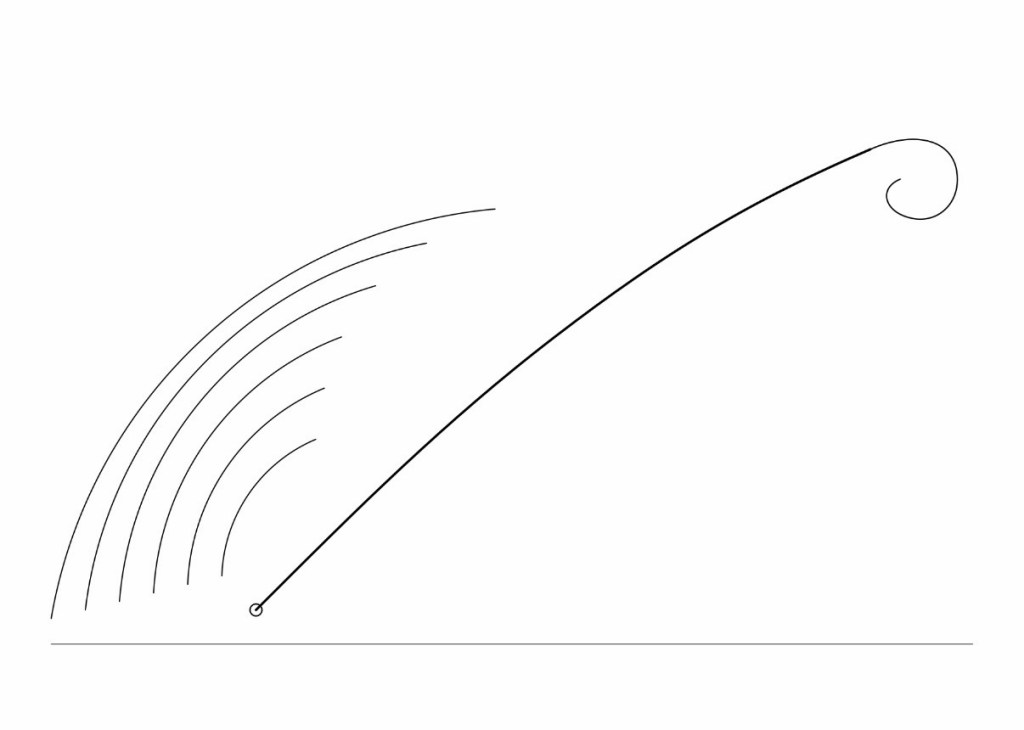
Mullā Ṣadrā’s doctrine of substantial motion (al-ḥaraka al-jawhariyya), developed in the third book of the Asfār al-arbaʿa, and Alfred North Whitehead’s reformed subjectivist principle, developed in Process and Reality (1929), arrive at the same conclusion from entirely different sources. The self is not a substance in which experiences occur. The self is the process of experiencing. I argue that both philosophers are correct on this claim, and that Ṣadrā’s version of the argument is stronger than Whitehead’s where they diverge: on teleology, on the survival of the subject, and on the possibility of sustained self-awareness.
The Avicennian Container
Ibn Sīnā, in the Ṭabīʿiyyāt of the Shifāʾ and the Najāt, restricted motion (ḥaraka) to the four accidental categories of quality, quantity, position, and place. Substance remained fixed beneath its accidental modifications. Ibn Sīnā defended the restriction on two grounds. Motion requires a subject (mawḍūʿ) that persists through the change and bears its successive states. If substance itself moved, nothing would serve as its subject. The change would require a sub-substance, generating an infinite regress or the admission of an ultimate fixed ground, which merely relocates the immobile substance without eliminating it. Ibn Sīnā’s second argument was from form. If the substantial form of a thing were to change, the thing would cease to be what it is. Such change is annihilation, the destruction of one substance and the generation of another. Ibn Sīnā categorised it as kawn wa fasād (generation and corruption), distinct from ḥaraka.
The Flying Man thought experiment reveals the picture of selfhood this substantialism produces. A fully formed adult is created suspended in void, limbs spread apart, all sensory input blocked. Ibn Sīnā argues that this person would affirm the existence of their self (wujūd dhāti-hi) without any sensory, imaginative, or reflective content. The experiment is commonly read as a proof of the soul’s immateriality. It is more precisely a proof of the soul’s self-subsistence: the soul knows itself by being itself, prior to any content. It is a room that exists before any furniture is placed inside it. Deborah Black’s work on Avicennian self-awareness (al-shuʿūr bi-al-dhāt) has complicated this picture. Her findings do not alter its implication. For Ibn Sīnā, the soul is a thing that has experiences. The Flying Man demonstrates that the thing exists independently of any particular experience.
Ṣadrā’s Response
Ṣadrā inherited the Avicennian conclusion about self-awareness and rejected the metaphysics that grounded it. The soul’s immediate self-awareness, for Ṣadrā, does not prove substantial self-identity. It demonstrates the soul’s existential act, its being-in-process, immediately given to the soul because the soul is the process.
The apparatus grounding the rejection operates at a deeper level than the question of motion. Ṣadrā reverses the Peripatetic priority between existence (wujūd) and quiddity (māhiyya). For Ibn Sīnā, the two are conceptually distinct but ontologically inseparable. Each contributes an irreducible dimension to the concrete thing. Quiddity determines what a thing is. Existence determines that it is. Suhrawardī had challenged this symmetry by arguing for the principality of quiddity (aṣālat al-māhiyya). Ṣadrā reverses Suhrawardī. Existence is the sole reality. Quiddity is a mental abstraction (iʿtibārī), a conceptual construct the mind derives from existence. A horse is an act of existing at a determinate grade of existential intensity. “Horseness” is what the mind abstracts from the act when it considers the act’s character and not its actuality.
If quiddity is an abstraction, the “substance” that grounds Peripatetic metaphysics is also an abstraction: a conceptual freeze-frame of a reality whose actual mode of being is existential act. Ibn Sīnā’s regress argument presupposes that substance is the kind of thing that requires a subject. On Ṣadrā’s account it is not. Substance is the act of existing. An act does not require a substrate in which to inhere. The flame is the burning. To ask what burns beneath the burning mistakes the question’s form for the world’s.
Mīr Dāmād, Ṣadrā’s teacher, had sensed the strain of the Peripatetic framework on a related problem before Ṣadrā’s intervention. The world’s temporal origination had generated an impasse between the Peripatetic position (the world is eternal) and the kalām position (the world was created at a first moment of time). Mīr Dāmād introduced the concept of ḥudūth dahrī, origination in perpetual time (dahr) as distinct from origination in serial time (zamān), to acknowledge that the relationship between the eternal and the temporal could not be captured by the categories available in Peripatetic metaphysics. The intervention opened a conceptual space. Mīr Dāmād did not use it. He continued to hold substance fixed in its essential determination once originated. Ṣadrā’s radicalism consists in denying this final concession.
Tashkīk and Substantial Motion
Substantial motion requires a scale along which substance can move. Ṣadrā provides it through tashkīk al-wujūd, the gradation of existence. The concept was not his invention. Suhrawardī had applied tashkīk to light in the Ḥikmat al-Ishrāq: light is a single reality varying in intensity from the faintest glow to the Light of Lights (nūr al-anwār). Ṣadrā transferred the structure from light to existence itself. Suhrawardī could not have made the transfer, given his denial of the principality of existence. Existence, on Ṣadrā’s account, is a single reality admitting of degrees of intensity, priority, and perfection. A stone exists less intensely than a plant; a plant less intensely than an animal; an animal less intensely than a rational soul; a rational soul less intensely than a separated intellect; all less intensely than the Necessary Being (wājib al-wujūd), pure existence without limitation. These are not different kinds of existence. They are different grades of a single existential act. The ordering is objective, intrinsic to existence itself.
Substantial motion is the claim that a particular existent can move along this scale. Its grade of being at one moment differs from its grade at an earlier moment. The continuity between grades is the continuity of a directed process, a single arc of intensification, and not the persistence of an identical entity beneath changing attributes. The soul (nafs), in the formulation that compresses the claim into a phrase, is jismāniyyat al-ḥudūth, rūḥāniyyat al-baqāʾ: bodily in origination, spiritual in subsistence. The phrase describes a single trajectory. The soul begins at the material grade of existence and, through substantial motion, intensifies toward the intellectual grade. It acquires rational capacities that were absent at its origination because those capacities belong to a higher grade of existential intensity than the one at which it began. The soul does not have a trajectory. The soul is the trajectory.
Ṣadrā offers three arguments for substantial motion. The first is from the temporality of accidents. The forms inhering in matter (heat, colour, spatial configuration) shift constantly. These forms depend for their existence on the substance in which they inhere. Substance itself must therefore be undergoing change. A stable cause cannot produce an unstable effect. A motionless ground cannot generate continuous motion in everything dependent on it. The argument relies on a principle of proportionality between cause and effect that one might resist. Its force is cumulative.
The second argument concerns the rational soul’s development. It begins material and ends intellectual. If the transformation is real and not merely apparent, something in the soul’s substance has changed. The difference between material and intellectual modes of existence is substantial, not accidental. Ṣadrā rejects the alternative position, that the soul was always intellectual and merely appeared to develop, as contrary to observation and to the Qurʾānic account of human creation from clay (ṭīn).
The third argument is cosmological. The universe exhibits continuous change at every level of organisation. If all such change were accidental, it would require a substantial ground entirely immune to change. Ṣadrā finds this implausible. The Peripatetic insistence on the immobility of substance is less a necessary truth than a refusal to follow the evidence of change to its ontological conclusion.
Selfhood Without Interior
Substantial motion dissolves the container view of the self. If what a being is is continuously reconstituted through its modifications, there is no interior. What one calls interiority is a quality of the process when the process becomes reflexively aware of its own direction. It is a fold in the movement. No space lies behind it. To say “I” is to designate a vector in the order of wujūd, a trajectory whose unity is given by its directedness and not by the persistence of a substrate.
Ṣadrā synthesises two doctrines to account for how a process can be aware of itself. The first is presential knowledge (ʿilm al-ḥuḍūrī), inherited from Suhrawardī. The second is the unity of the knower and the known (ittiḥād al-ʿāqil wa-l-maʿqūl), developed from a tradition reaching back through Aristotle’s noēsis noēseōs.
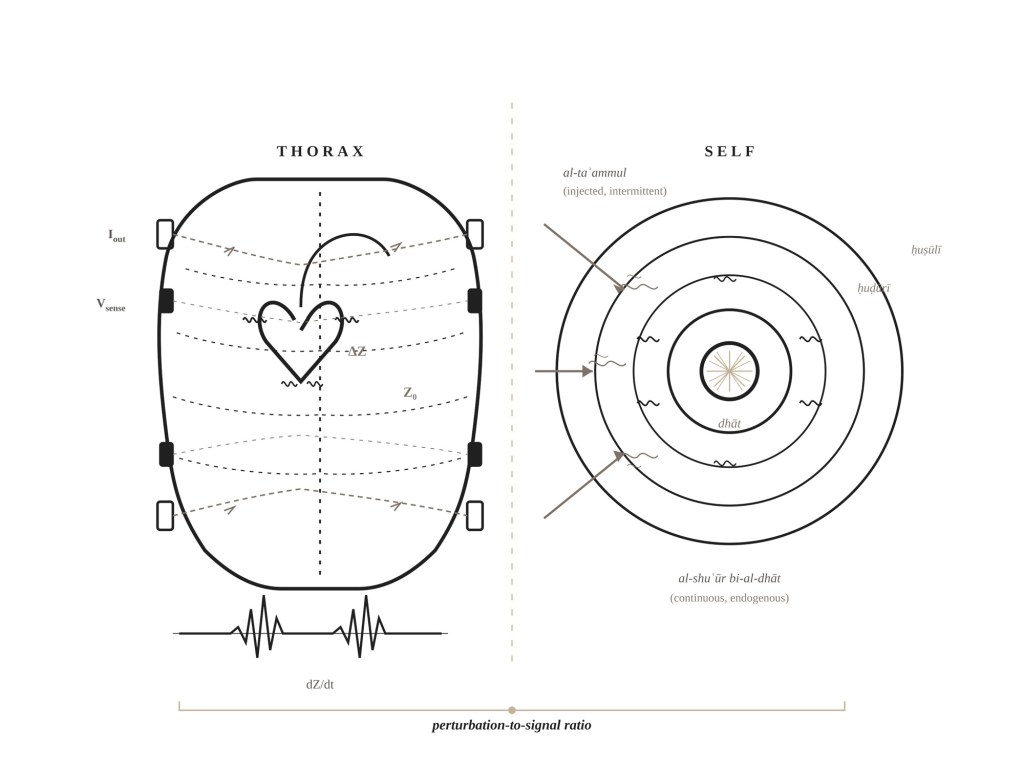
Suhrawardī’s contribution is the distinction between presential and representational knowledge (ʿilm ḥuḍūrī and ʿilm ḥuṣūlī). Presential knowledge is direct. The self is present to itself without the mediation of a mental representation. The directness avoids the regress that would follow from requiring an image of the self in order to know the self. Representational knowledge introduces a mediating structure between knower and known: the concept, the category, the linguistic label. Presential knowledge introduces none. The self’s being is its self-knowledge, identical with its existence and not housed inside it.
Ittiḥād al-ʿāqil wa-l-maʿqūl radicalises the picture. The Peripatetic account has the intellect receive an intelligible form, abstract it from its material conditions, and instantiate it in the immaterial medium of the intellect. The form in the intellect is numerically identical with the form in the thing, differing only in mode of existence. Ṣadrā goes further. In intellection, the knower becomes the form. The intellect, in knowing the intelligible, undergoes an existential transformation and achieves a new grade of being identical with the grade of the object known. Knowledge is an existential event. The knower becomes the known. Self-knowledge is the limiting case: the self knows itself by being itself, and this being-itself is the presential awareness accompanying substantial motion at every grade of the trajectory. There is no gap, no intermediary. Knower and known are existentially identical.
Jari Kaukua (2014) argues that Ṣadrā nevertheless holds a form of self-opacity. Full knowledge of one’s own essence remains partially inaccessible, a mismatch between the complexity of what one is and the capacity of any single reflexive act to capture it. I call this the bandwidth problem. The soul at a given grade of existential intensity is fully present to itself in the mode of ḥuḍūr. It cannot fully represent itself to itself in the mode of ḥuṣūl. Representation requires a conceptual apparatus that discretises what is continuous and fixes what is in motion. Presential self-awareness escapes the distortion by being non-representational, but at the cost of being incommunicable, unavailable for propositional articulation. A knowing that cannot be told. The asymmetry between fidelity and communicability follows from what the self is and cannot be corrected by refining the method of self-examination.
The Cartesian-Kantian Tradition
Whitehead’s opponents are Descartes, Locke, Hume, and Kant. The problem that drives him is the fate of substance across the arc of modern European philosophy.
Descartes bequeathed modernity a second version of the substantialist picture. In the Meditations and the Principles, the self is thinking substance (res cogitans): a thing whose essence is thought, whose existence is established by the cogito, and whose identity consists in the continuous exercise of its essential attribute. Experiences (modes of thinking) occur within the substance.
Locke modified the picture in Essay Concerning Human Understanding II.xxvii without abandoning it. Personal identity consists in the continuity of consciousness, specifically memory, and not in the persistence of the same substance. I am the same person as the one who experienced yesterday’s events if and only if I can remember those events as my own. The substance may change without affecting personal identity, provided consciousness extends itself backwards through memory. Locke relocated the container from substance to consciousness. The contents changed from substantial attributes to memories. The picture survived.
Hume pushed Locke’s empiricism to its sceptical limit in Treatise I.iv.6. Looking inward, he found no continuous experiencer behind the flow of impressions and ideas, only the flow itself, a bundle of perceptions succeeding each other with great rapidity. The bundle theory appears to abolish the container. Hume himself acknowledged in the Appendix that his theory could not account for the felt unity of personal identity. He could neither explain the unity nor abandon his failure to do so. The bundle theory is the Cartesian picture in crisis: the container emptied and found to consist of nothing but its contents, yet the contents behave as if a container exists.
Kant resolved the crisis at a higher level of abstraction in the first Critique. He distinguished the empirical self (the self as it appears to introspection, a succession of inner states subject to the form of time) from the transcendental self (the “I think” that must be able to accompany all representations, the transcendental unity of apperception that is the formal condition of experience itself). The transcendental self is a logical function, the form of self-consciousness that structures experience from within. It is not a substance in the Cartesian sense. Kant preserved the unity Hume could not account for while denying that this unity is the unity of a thing. The transcendental self, however, cannot undergo change, cannot develop, cannot intensify. Kant solved the unity problem at the cost of making the self entirely static at the transcendental level. The Kantian transcendental unity of apperception is the modern European analogue of the Peripatetic immobile substance. Whitehead recognised it as such.
Ibn Sīnā, Descartes, Locke, Hume in his wavering moments, and Kant share the same assumption: the subject is ontologically prior to its experience. The subject exists. The experience happens to it. Every move within the tradition is a move within the relation between a pre-given subject and its contents. Ṣadrā rejects the assumption at the Avicennian end. Whitehead rejects it at the Kantian end.
Whitehead’s Response
Whitehead diagnoses the tradition as vitiated by the “fallacy of misplaced concreteness,” the error of treating an abstraction as a concrete reality. The Cartesian substance, the Lockean consciousness, the Humean bundle, the Kantian transcendental unity: each is an abstraction from the concrete reality of experience. Each becomes a philosophical problem because it is treated as more fundamental than the experience from which it was abstracted. Whitehead reverses the order of explanation. The concrete reality is the act of experiencing. Any account that begins with a pre-constituted subject and asks how it relates to its experience has reversed the order of priority.
The reformed subjectivist principle retains what is correct in the subjectivist turn: experience is always experience for a subject. Whitehead eliminates the container the tradition erected around the subject. The unreformed principle, traced from Descartes through the British empiricists, holds that the primary data of experience are private to the experiencing subject, “in” the mind the way objects are in a box. The reform denies the box. Experience is constitutive of the subject. The subject does not precede its experience. It is constituted by the process of experiencing. “The subject emerges from the world,” Whitehead writes, and the claim is that the subject does not pre-exist the emergence.
Whitehead grounds the principle in what he calls the Category of the Ultimate: creativity, the many, and the one. Creativity is the principle by which the many become one and the one becomes part of a new many. It is the principle of novelty. It is not itself an actual entity. It is the universal of universals, the formless productive power every actual entity instantiates in its own way. The many are the settled facts of the completed world, the actual occasions already concrescent and perished as subjects. The one is the novel actual occasion arising from the many through the creative act of concrescence. The parallel to wujūd in Ṣadrā’s system is suggestive. Both creativity and wujūd function as the ultimate principle of actuality. The parallel is also misleading. Ṣadrā’s wujūd is graded and hierarchical. Whitehead’s creativity is uniform and democratic, instantiated equally in every actual occasion regardless of its place in any hierarchy of complexity or value.
The doctrine of actual occasions is Whitehead’s worked-out apparatus. An actual occasion is a quantum of process, a unit of becoming that comes into being through “concrescence,” a growing-together of the data it receives from prior actual occasions into a novel unity. The basic relational act is “prehension,” Whitehead’s generalisation of perception. A prehension can be positive (a “feeling,” in which the datum is incorporated into the new occasion’s constitution) or negative (an exclusion of the datum, itself a determinate act). Concrescence unfolds through phases: conformal feeling (the new occasion inherits and repeats the feelings of its predecessors), supplementary feelings (the inherited data are integrated, compared, evaluated), and satisfaction (the achievement of a fully determinate unity). At satisfaction, the actual occasion perishes as a subject and becomes “objectively immortal,” a datum available for prehension by subsequent occasions.
The subject does not exist before concrescence begins. The subject is the concrescence. When concrescence reaches satisfaction, the subject perishes as an experiencer and survives only as an experienced datum. “No thinker thinks twice,” Whitehead writes; “no subject experiences twice.” Personal identity is a “society” of actual occasions linked by mutual inheritance of a common “defining characteristic.” The inheritance is real. Personal identity feels continuous because the pattern propagates through the series. The reality of the pattern is not the reality of a single continuous subject.
Whitehead’s God is dipolar. The primordial nature is the eternal envisagement of all possibilities, all “eternal objects.” The consequent nature is God’s ongoing reception of completed actual occasions into the divine experience. The primordial nature provides the “initial aim” for each new actual occasion: a lure toward the best possibility available in the given circumstances. The lure is persuasive, not coercive. The actual occasion can deviate from it. No mechanism guarantees convergence toward maximal value. The role of God in Whitehead’s system bears directly on the question of evaluative direction I return to below.
Convergence
Ṣadrā and Whitehead agree on what selfhood is not. Both deny that the subject is ontologically prior to its experience. Both hold that the being of the subject is constituted by its becoming and does not persist beneath it as a stable substrate. Both preserve real unity without collapsing it into static identity. Ṣadrā secures unity through the continuity of a single arc of existential intensification along the grades of wujūd. Whitehead secures it through the inheritance of pattern across a temporally ordered series of actual occasions. Both locate the error of their opponents in the reification of an abstraction. Whitehead names the error the fallacy of misplaced concreteness. Ṣadrā does not name it. His critique of the Peripatetic insistence on the immobility of substance is the same critique. The Peripatetics mistook a conceptual abstraction (quiddity, the fixed “what” of a thing) for the concrete reality (existence, the act by which the thing is) and treated the abstraction as the ground of the reality.
The temptation is to read the convergence as a single philosophical insight in different vocabularies. Tashkīk al-wujūd maps suggestively onto Whitehead’s hierarchy of categories; ḥaraka jawhariyya maps onto concrescence; the soul’s trajectory from materiality to intellectuality maps onto the serial inheritance of pattern. I resist the mapping. The divergences between the two philosophers matter for what selfhood is, how it endures, and what it can know of itself.
Divergences, and Why Ṣadrā Is Stronger
Three divergences separate Ṣadrā from Whitehead. Ṣadrā’s framework is stronger on each.
Teleology. Ṣadrā’s process is teleological in a strong sense. The soul moves from material to intellectual because the grades of wujūd are ordered by degrees of perfection. The process of intensification is directed toward a determinate summit: intellectual subsistence, the survival of the soul beyond the body as a fully actualised intellect. The summit is given by the structure of being. The Necessary Being is the maximal grade of existence. The soul’s trajectory of intensification is a trajectory toward God in a metaphysically precise sense. To become more intensely existent is to become more proximate to the Necessary Being. Whitehead’s actual occasions carry no predetermined summit. Each achieves its own satisfaction and perishes. The direction of a personal society of occasions is a product of accumulated inheritance and the influence of God’s initial aim. The aim is persuasive and guarantees no particular outcome. Ṣadrā’s universe is Neoplatonic: an emanative hierarchy the soul ascends in the process of return (rujūʿ) to the source. Whitehead’s is a democracy of occasions. Their order emerges from mutual prehensions and gentle divine persuasion, not from a pre-given scale of perfection.
A processual account of selfhood needs a criterion by which some intensifications count as growth and others as drift. Ṣadrā has one built in. Whitehead has at best the fainter outline of one. Ṣadrā provides the self with an objective measure of its own movement. Whitehead’s standard is aesthetic (greater intensity of experience, richer contrast) and less obviously objective.
Perishing. Whitehead’s actual occasions perish utterly as subjects at the moment of satisfaction. They achieve objective immortality as data in the experience of later occasions. Their subjective immediacy is extinguished. The self that endures is a society of occasions, not a subject persisting through the series. Ṣadrā’s soul does not perish in this way. The trajectory from materiality to intellectuality is a single continuous process in which the soul’s mode of being changes and the soul itself does not undergo the subjective annihilation Whitehead’s occasions undergo at each moment. The soul at the intellectual grade is the same soul that was at the material grade, the same in the sense of processual continuity: one arc, one directed movement. The consequence is direct. Ṣadrā can affirm personal survival after death on processual grounds. Whitehead cannot, or can only in an attenuated sense.
The question of fanāʾ, the Sufi concept of the annihilation of the self in God, might seem to favour Whitehead. Fanāʾ could be read as Whiteheadian perishing: the cessation of subjective immediacy in which the self becomes a datum for God’s consequent nature. The reading is imprecise. Ṣadrā’s fanāʾ is intensification and not destruction. It is the soul’s arrival at the highest grade of existential intensity accessible to it, a grade so proximate to the Necessary Being that the distinction between self and God becomes vanishingly thin without collapsing. The grades of tashkīk are continuous. The Necessary Being’s existence is qualitatively different from existence with any degree of limitation, however minimal. Fanāʾ is asymptotic. The soul approaches the summit without reaching it. The summit is infinite existence and the soul, however intensified, remains finite. Whitehead’s framework cannot accommodate this reading. His occasions do not approach God by becoming more intensely existent. They are received into the consequent nature after they have completed their becoming.
Self-awareness. Ṣadrā’s framework does what Whitehead’s cannot. The synthesis of ittiḥād al-ʿāqil wa-l-maʿqūl with the Ishrāqī account of ʿilm ḥuḍūrī produces a developed theory of how a processual self can be aware of itself as a process. The self knows itself presentially, by being itself. This being-itself is an existential act accompanying substantial motion at every grade of the trajectory. Whitehead’s account of self-awareness is thinner. An actual occasion has a “subjective form,” a way-of-experiencing that qualifies its prehensions. The integration of subjective forms into the final satisfaction constitutes a kind of reflexive unity. Whitehead does not develop a theory of self-awareness comparable to Ishrāqī ḥuḍūr. The question of how an actual occasion knows itself as the subject of its own experience remains one of the underdeveloped regions of his system. The omission follows from the doctrine of actual occasions. Whitehead’s occasions are atomic units of process that perish at completion. The sustained self-presence ḥuḍūr describes requires a subject that endures through time. Ṣadrā’s processual subject endures as a single arc of intensification. It can sustain presential self-awareness. Whitehead’s cannot.
The felt quality of being a person includes a quality of continuous self-presence. One is always already with oneself, pre-reflectively, before any deliberate act of introspection. This self-presence is not interrupted by sleep or distraction as attention or memory is interrupted. Whitehead’s occasionalist metaphysics has difficulty with this datum. The datum requires a subject that persists across moments and not one that perishes and is reborn at each. Ṣadrā’s framework captures the datum. The capture does not prove Ṣadrā’s metaphysics correct. The datum itself may be less straightforward than it seems. The felt continuity of self-presence may be a retrospective construction, a product of memory and not a report of an ongoing condition. Whitehead’s framework requires supplementation at this point, whether from within or from without.
Anattā as Triangulation
The Buddhist doctrine of anattā (no-self) helps locate the two positions. It represents the view Ṣadrā and Whitehead reject as firmly as they reject the Avicennian and Cartesian pictures. Anattā, in its Theravāda formulation, holds that there is no self at all. What one calls the self is a conventional designation applied to a stream of momentary psychophysical events (dharmas) that arise and pass away in rapid succession. The impression of a continuous self is an illusion generated by the speed of the succession and the habits of conceptual imputation. Whitehead’s actual occasions resemble dharmas in their momentariness and their perishing. The resemblance has been noted in the comparative literature. Whitehead, unlike the Theravāda tradition, insists that the society of actual occasions constituting a person has real unity, a pattern of inheritance that distinguishes it from random succession. Ṣadrā is further still from anattā. The soul is a real, unified, continuous process of existential intensification. Its unity is intrinsic and is not imposed by conceptual imputation.
Both philosophers occupy the space between the substantialist self and the Buddhist no-self. The self is real. It is a process. It is unified without being static. It is continuous without being identical. Ṣadrā and Whitehead carve the narrow space differently. What separates them from anattā matters more than what they share with it.
Language
Both philosophers fight their own sentences. Subject-predicate syntax, which organises every natural language in which philosophy has been written, embeds the substance-attribute ontology they are trying to escape. “The soul intensifies” parses as a subject (the soul) performing an action (intensifying). The sentence suggests that the soul is one thing and the intensifying is another. The point of substantial motion is that the soul is the intensifying. “The actual occasion concresces” has the same problem. Whitehead responds with relentless neologism. Ṣadrā repurposes technical vocabulary in ways that strain its Peripatetic origins. The difficulty is evidence that the substance-attribute picture is a feature of the conceptual apparatus embedded in ordinary speech and not merely a philosophical thesis. Its dislodgement requires the sustained technical labour the Asfār and Process and Reality represent.
Henri Bergson faced the same difficulty in his account of durée (lived duration). The intellect, whose natural operation is the analysis of continuous process into discrete spatial units, systematically distorts the temporal reality it attempts to grasp. Bergson concluded that only intuition, a mode of sympathetic identification with the flow of experience, could access durée as it actually is, prior to its spatialisation by the intellect. Bergson’s intuition parallels Suhrawardī’s presential knowledge. Both are modes of direct acquaintance that bypass the representational apparatus. Both share the liability of being incommunicable. Any attempt to articulate what intuition grasps requires the very apparatus that distorts it. Bergson’s durée is not graded in the way Ṣadrā’s wujūd is. It lacks the teleological orientation toward a determinate summit. What Bergson and Ṣadrā share is the recognition that process is ontologically prior to product, and that language systematically misrepresents this priority.
Moral Responsibility
The most common objection to processual selfhood concerns moral responsibility. If the self is its becoming, if no fixed substrate persists through change, what grounds the attribution of responsibility to a person for actions performed at an earlier stage of the trajectory? The objection is a version of the problem that has attended every non-substantialist account of personal identity since Locke. The self that committed the act and the self held responsible are not the same self in the sense of static identity. They are continuous in the sense of belonging to the same trajectory.
Ṣadrā’s answer is implicit in his eschatology. The arc of substantial motion constitutes a real unity. The later stages inherit and incorporate the earlier in the way an intellectual achievement incorporates the material conditions from which it arose. The soul facing divine judgment is the same soul that acted in the world, the same in the sense of processual continuity. It bears the accumulated character of the entire arc: its choices, its failures to intensify, folded into the existential grade at which it arrives.
Whitehead’s answer parallels Ṣadrā’s. The society of actual occasions constituting a person at the time of judgment inherits, through the chain of prehensions, the character of the occasions constituting the person at the time of the act. Neither answer is forced by the processual account into denying moral accountability. Both ground responsibility in processual continuity and not in substantial identity. Whether either answer is fully adequate is a separate question. The objection does not defeat the processual account.
Conclusion
I take Ṣadrā to be philosophically stronger than Whitehead on the disputed points. The grades of existence constitute an objective ordering. Some modes of being are more real than others, in the precise sense of being more intensely existent. The trajectory of the self can be evaluated by its movement along the ordering. This preserves something important that Whitehead’s framework risks losing: the process of becoming has a criterion external to itself, and there is a difference between intensification and mere change, between growth and drift. Whitehead has resources for the distinction through God’s initial aim and the aesthetic criterion of intensity. The resources are thinner and less determinate than Ṣadrā’s grades of wujūd. They leave the question of evaluative direction more open than I am comfortable with.
The shared ground between the two philosophers is the more important point. The self is its becoming. Interiority is a fold in the process. No space lies behind it. The container is an abstraction. The movement is the reality. The characteristic anxieties about selfhood need reformulation. One does not lose a self. One abandons a trajectory. Authenticity is fidelity to a direction and not correspondence to a fixed interior. Self-knowledge, at its most faithful, is a quality of attention to the process of one’s own becoming: an awareness lived before it is said and losing something essential in the saying.
The substantialist view encourages the opposite. It suggests one should look inward, find the self, determine its properties, then act accordingly, as if the self were an inventory to be taken before a journey and not the journey itself. The processual account suggests the journey is what matters. The direction of movement is the most important thing to know about oneself. The knowledge is available pre-reflectively and continually, in the felt quality of one’s own becoming.
Trust the direction more than the inventory. The parallel to the principle I drew from impedance cardiography, that one should trust the trends more than the absolute values, is parallel in form and not substance. I claim no more for it than the form warrants. The resonance holds. In cardiology and in conscience, the attempt to fix one’s exact location introduces more distortion than the attempt to identify the direction of movement. The direction is what matters for the decisions that need to be made.
Recommended Reading
Primary: Islamic philosophy
1. Mullā Ṣadrā, al-Ḥikma al-mutaʿāliya fī al-asfār al-ʿaqliyya al-arbaʿa. Third book for substantial motion and the soul.
2. Ibn Sīnā, al-Shifāʾ: al-Ṭabīʿiyyāt and al-Ilāhiyyāt. Marmura’s translation of the Ilāhiyyāt (Brigham Young University Press, 2005) is standard in English.
3. Ibn Sīnā, al-Najāt. Shorter parallel treatments of motion and the soul.
4. Suhrawardī, Ḥikmat al-Ishrāq. Walbridge and Ziai, The Philosophy of Illumination (Brigham Young, 1999). For tashkīk applied to light and for presential knowledge.
5. Mīr Dāmād, al-Qabasāt. For ḥudūth dahrī.
Primary: Western philosophy
6. Alfred North Whitehead, Process and Reality. Corrected edition, ed. Griffin and Sherburne (Free Press, 1978).
7. Descartes, Meditations on First Philosophy and Principles of Philosophy. Cottingham, Stoothoff, and Murdoch, The Philosophical Writings of Descartes (Cambridge).
8. Locke, Essay Concerning Human Understanding II.xxvii. Nidditch edition.
9. Hume, A Treatise of Human Nature I.iv.6 and Appendix. Norton and Norton edition.
10. Kant, Critique of Pure Reason. Guyer and Wood translation.
11. Bergson, Time and Free Will; Matter and Memory; Creative Evolution.
Secondary: Ṣadrā and Avicennian self-awareness
12. Jari Kaukua, Self-Awareness in Islamic Philosophy: Avicenna and Beyond (Cambridge, 2015). Chapters 7 and 8 on Ṣadrā are the direct interlocutors.
13. Deborah L. Black, “Avicenna on Self-Awareness and Knowing That One Knows,” in Rahman, Street, and Tahiri, eds., The Unity of Science in the Arabic Tradition (Springer, 2008), 63–87.
14. Sajjad Rizvi, Mullā Ṣadrā and Metaphysics: Modulation of Being (Routledge, 2009).
15. Ibrahim Kalin, Knowledge in Later Islamic Philosophy: Mullā Ṣadrā on Existence, Intellect, and Intuition (Oxford, 2010).
16. Christian Jambet, The Act of Being: The Philosophy of Revelation in Mullā Sadrā, trans. Jeff Fort (Zone Books, 2006).
17. Seyyed Hossein Nasr, Ṣadr al-Dīn Shīrāzī and His Transcendent Theosophy (Institute for Humanities and Cultural Studies, 1997).
18. Muhammad Kamal, Mulla Sadra’s Transcendent Philosophy (Ashgate, 2006). Contains direct comparative material on process thought.
Secondary: Whitehead
19. Donald W. Sherburne, A Key to Whitehead’s Process and Reality (University of Chicago, 1966). Standard reader’s companion.
20. David Ray Griffin, Whitehead’s Radically Different Postmodern Philosophy (SUNY, 2007).
21. Judith A. Jones, Intensity: An Essay in Whiteheadian Ontology (Vanderbilt, 1998). Relevant to the aesthetic-intensity criterion the essay finds insufficient.
22. Isabelle Stengers, Thinking with Whitehead: A Free and Wild Creation of Concepts (Harvard, 2011).
Comparative: no-self
23. Mark Siderits, Buddhism as Philosophy (Ashgate, 2007). For anattā in an analytic frame.
24. Miri Albahari, Analytical Buddhism: The Two-Tiered Illusion of Self (Palgrave Macmillan, 2006). The strongest contemporary case for the position the essay triangulates against.
 Paimana
Leave a comment