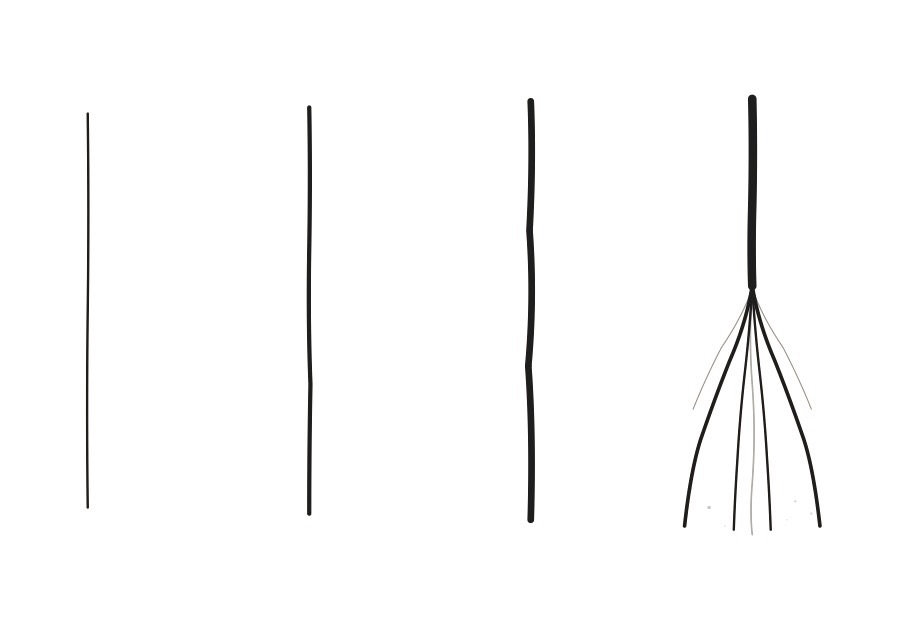
Four verbs in Qayyum Nazar’s nazm “Jawani,” dekhā, chāhā, paayā, rauñdā (seen, desired, attained, trampled), constitute a more precise account of how imperial violence operates than most poems that devote their entire length to the subject. One per stanza, each governing a different civilizational geography and each producing a different somatic consequence in the refrain that closes every stanza. The sequence describes one process distributed across four stages, the process by which looking at something beautiful becomes, by increments that the poem presents as grammatically inevitable, the destruction of the thing looked at. The poem names no historical event, invokes no solidarity, adopts no political stance in any recognizable sense; it constructs a grammar, and the grammar does the rest.
Nazar sets this sequence in a paband nazm, the most formally constrained structure the Urdu tradition offers: metered, rhymed, stanzaically regular, closed at each turn by a refrain. The conservatism of the vessel turns out to be the condition of the poem’s central achievement, in that the poem could not produce its final effect without the rigidity of expectation that only strict repetition can establish and only strict variation can break. This claim, if it holds, has consequences beyond the reading of a single poem, because it suggests that formal conservatism within Urdu modernism can function as a mode of political intelligence, that the inherited constraints of the paband form enable a kind of cumulative rhetorical force unavailable to either the ghazal’s paratactic couplets or free verse’s unmoored lineation.
The Fettered Form
The word paband means fettered. A paband nazm maintains both the traditional metre (behr) and end-rhyme (qāfiya, sometimes with radīf) that the broader nazm form encompasses but does not require. K.C. Kanda’s Masterpieces of Urdu Nazm, the standard English-language anthology, provides the useful classification. The spectrum runs from most to least constrained: paband nazm (metre, rhyme, equal line length), nazm-e-mo’arrā or blank verse (metre and equal line length without rhyme), āzād nazm or free verse (inner rhythm, unequal lines, without end-rhyme), and the disputed category of nasrī nazm or prose poem.
What is worth registering about this spectrum is not that it organizes a set of technical options, which it does, but that it acquired over the course of mid-twentieth-century Urdu literary history an ideological valence that ran in one direction: from constraint toward liberation, from the inherited toward the new. The Halqa-e-Arbab-e-Zauq, the literary circle that did more than any other institution to establish modernist poetry in Urdu, is broadly identified with the liberating end of this spectrum, though the identification, as I will argue, obscures a good deal.
N.M. Rashid, widely credited as the father of modernism in Urdu for his pioneering introduction of free verse, made the case against the paband form with considerable philosophical force. A. Sean Pue’s I Too Have Some Dreams, the definitive English-language study of Rashid, demonstrates that the break with traditional form was driven by content: Rashid’s engagement with sexuality, embodiment, and existential doubt required modes of expression that classical prosody could not, in his view, accommodate. Muhammad Hassan’s canonical assessment captures a related complaint from the Progressive side: most Urdu poets “don’t compose verse; rather, the qāfiya composes verse through them.” It was against this tyranny (the Urdu word is jabr, which carries connotations of compulsion and oppression) that the āzād nazm was born. Rashid published Maavra (The Beyond) in 1941, and the collection is now treated as the founding document of Urdu free verse.
Within this history, one fact has received remarkably little attention. The founding secretary of the Halqa-e-Arbab-e-Zauq, the person who organized its first meeting in 1939 under the name Bazm-e-Dastango (Storytellers’ Gathering), who held the secretaryship from 1944 to 1955, who brought Meeraji into the circle, and who compiled the influential anthology Behtreen Nazmen (Best Nazms, 1948), was Qayyum Nazar, a poet who worked primarily in the paband nazm and the ghazal. The Halqa, in other words, was not constituted by a shared commitment to formal experiment so much as by a shared commitment to literary seriousness, which is a different thing, and which accommodated Rashid’s free verse and Nazar’s paband work within the same institutional space. Meeraji himself, the poet credited with founding symbolism in Urdu, published a collection titled Paband Nazmein (Bound Nazms) in 1968, which suggests that even for the most experimental members of the circle, the fettered form retained its viability as a vehicle for serious work. The Halqa’s aesthetic commitments, as articulated by the poet Akhtarul Iman, centred on literary quality rather than formal prescription: “all literary writing must be literary first.”
A critical essay by Ayub Nadeem in Tahqeeq Nama, the journal of Government College University Lahore where Nazar himself taught, provides the most precise formulation of what Nazar’s formal practice entailed. Nadeem describes Nazar as a poet who “evolved most of these poetic forms from the existing forms of Urdu,” and the word “evolved” carries a precision worth pausing over, because it specifies the relationship between Nazar’s work and the tradition as one of internal development rather than rupture. Where Rashid brought free verse into Urdu as something genuinely new, Nazar found within existing stanzaic structures (the band forms of the musaddas and mukhammas, the refrain mechanisms of the tarjī’-band) resources that could be developed in modernist directions while maintaining continuity with the inherited repertoire. There is no need to choose between these approaches in order to read either poet well, and the fact that literary history has tended to narrativize them as a choice, with free verse representing progress and the paband form representing what was left behind, is precisely the kind of critical habit that a poem like “Jawani” makes it difficult to sustain.
How a Pattern Becomes an Argument
The paband nazm enables a mode of rhetorical construction that other Urdu poetic forms cannot replicate, and what I want to specify is what that mode is.
The ghazal, the dominant lyric form in the Urdu tradition, operates through what Frances Pritchett has described as “a series of semantically independent two-line mini-poems that have a strong formal unity but usually no unity beyond that.” Agha Shahid Ali’s phrase for this was “ravishing disunities.” Each she’r is a self-contained utterance, retaining its sense and force when detached from the poem, and the ghazal’s radīf (refrain ending each couplet’s second line) creates a centripetal, performative dynamic in which each couplet orbits the same verbal centre independently. In traditional mushaira recitation, the audience calls out the radīf in a kind of call-and-response, and the recitation can begin and end at any couplet without loss of coherence. The form is paratactic. Its couplets accumulate around a mood rather than building toward a conclusion.
By this I do not mean that the ghazal is a lesser form, but rather that its logic is centripetal where the nazm’s is linear. Kanda’s formulation: “A nazm must have a controlling thought or idea, discussed, developed and concluded, with due regard to the laws of poetic composition.” Ideas, images, and rhetorical progression are woven across stanzas; meaning deepens through the poem rather than resetting with each unit. The paband nazm adds to this accumulative logic the discipline of recurring musical pattern. Metre and rhyme create a rhythmic expectation against which the developing argument unfolds, and each return of the rhyme scheme deepens and transforms the meaning established in previous stanzas. The tension between the forward movement of intellectual development and the recursive pull of the sonic architecture gives the paband nazm a specific rhetorical capacity: the capacity to make an argument feel inevitable rather than merely stated, because the regularity of the form generates a norm against which the poem’s incremental variations register as stages in a progression rather than as independent observations.
A deviation within a pattern is legible as a deviation only because the pattern has been established. Free verse, which has no recurring frame against which variation can be measured, can state an escalation; the paband form enacts one, by training my ear to expect the pattern and then riding the pattern toward a conclusion that feels, by the time it arrives, as though it could not have been otherwise. The formal constraints are conditions for a specific kind of saying: the kind in which regularity generates expectation, expectation generates trust, and the violation of trust in the final stanza carries a force proportionate to the regularity that preceded it.
Four Stanzas, One Process
The opening stanza:
tū ne dekhā hai use jaate hue arz-e-hijāz
kitnā mauzūñ thā javāñ-qadd-e-darāz
dil meñ khubā jaatā hai
You have seen it, departing across the plains of the Hijaz, how fitting was that tall figure of youth. The heart sinks.
The word that governs the stanza is mauzūñ, which carries in classical usage a strong aesthetic charge: a sense of harmoniousness between a thing and its context. The tall figure crossing the Hijaz belongs to the landscape in a way that produces, in the one who watches it leave, a somatic consequence of a specific kind. The heart does not break or ache but is driven inward, khubā, as though pressed into the ground. This is a stanza about looking, and looking already costs something.
The address to tū is intimate, familiar, and in this context slightly accusatory, the kind of “you” that assumes shared knowledge between speaker and addressee. I do not yet know who is being addressed or from what position. The stanza withholds that information and gives instead a geography (the Hijaz, the Arabian heartland), a figure (javāñ-qadd-e-darāz, the tall-statured youth), and a consequence (the heart sinks). The relationship between these three elements is the poem’s subject, though I cannot see this yet.
The second stanza shifts geography and, more importantly, shifts the mode of encounter:
tū ne chāhā hai use misr abul-haul jamāl
kitne mardāna the us ke khad-o-khāl
dard baḌhā jaatā hai
You have desired it, the beauty of Egypt’s Sphinx, how masculine were its features. Pain increases.
The Sphinx is invoked through its khad-o-khāl, its features, its physiognomy, rather than through its mystery or antiquity, which would be the expected literary move. The word mardāna specifies further: this is a beauty of a specific kind, and wanting it does not produce new suffering so much as it intensifies what was already there. The verb construction baḌhā jaatā hai is progressive, ongoing. Pain was already underway; desiring makes it grow.
I begin to see the poem’s propositional logic. Each stanza opens with the same tū ne address, follows with a verb, locates the encounter in a civilizational geography, and closes with a bodily consequence. The verbs escalate: dekhā, then chāhā. Seen, then desired. Each stage contains the next as its implication. And the pabandform’s regularity, the repeating stanzaic structure, the recurring rhyme, the identical syntactic frame at each stanza’s opening, makes this escalation feel grammatically inevitable rather than merely willed, because my ear has already internalized the pattern and the pattern carries the argument forward.
The third stanza crosses a threshold:
tū ne paayā hai use sham-e-shabistān-e-france
kis qadar garm thā us kā har sāañs
jism jalā jaatā hai
You have attained it, the candle of the bedchambers of France, how warm was its every breath. The body burns.
Paayā is a different kind of verb than dekhā or chāhā. Seeing and desiring are relational; they preserve the distance between subject and object. Attainment collapses that distance, and the consequence moves outward from the interior of the heart to the surface of the body, from sinking and aching to burning. The image of the sham-e-shabistān (the candle of the bedchamber) works simultaneously in two registers: erotic (the warm breath, the intimate space) and imperial (France as a site of civilizational encounter, its beauty something to be had). The poem holds both registers in play without resolving them, because both require the same verb.
The geographical progression is not incidental. Hijaz, Egypt, France: three civilizational nodes tracing a westward arc that is also, read against the grain of colonial history, the arc of imperial encounter. Iqbal, the towering presence behind all modern Urdu poetry that deals in civilizational geography, used the Hijaz, Cordoba, and “the East” as coordinates in an explicitly polemical argument about Islamic civilizational energy. Javed Majeed’s scholarship has identified three conflicting elements in Iqbal’s geographical imagination: sacred space, political territoriality, and the interiority of selfhood. Nazar’s geographical imagination in “Jawani” operates on entirely different terms. Where Iqbal’s geographies serve a civilizational polemic, Nazar’s serve a structural argument. The Hijaz, Egypt, and France are placed in sequence not because they represent stages in a cultural narrative but because the sequence is the argument itself: first you look, then you desire, then you attain, and in each case the geography specifies the register of the beauty encountered without disrupting the grammar of the encounter, a grammar that operates the same way everywhere.
And then the final stanza:
tū ne rauñdā hai use jañg luTā merā suhāg
mādar-e-gītī mire vāste jaag
vaqt uḌā jaatā hai
The Suhāg Turn
The verb rauñdā completes the sequence: dekhā, chāhā, paayā, rauñdā. Seen, desired, attained, trampled. The four stages are one process, and the formal repetition, the insistent tū ne… hai use at the opening of each stanza, builds over the poem’s duration a feeling of mechanism, of something unfolding according to a logic that precedes any individual intention.
The more consequential move, however, is the shift in voice, and it is here that the paband form’s capacity for controlled violation becomes fully legible. For three stanzas I have internalized a grammatical frame: tū ne [verb] hai use, followed by a geographical location, followed by an aesthetic observation, followed by a somatic refrain. The frame is masculine, apostrophic, accusatory. The tū is someone who acts; the use is something acted upon. By the fourth stanza this pattern has been absorbed so thoroughly that any deviation registers with disproportionate force.
Jañg luTā merā suhāg. War has plundered my bridal fortune. The voice that enters is unmistakably gendered. The word suhāg designates the married woman’s auspicious state, the condition marked by sindūr, bangles, toe rings, and mangalsūtra, a condition that the scholarly literature on South Asian women’s folk traditions describes as a time of abundance and fruitfulness, emotionally dense with the love and companionship of a mate. The destruction of suhāg (broken bangles, wiped sindūr, the onset of widowhood) is one of the most potent metaphors for war’s devastation in the literary and oral traditions of the subcontinent. The suhāg geet, songs of bridal auspiciousness sung during wedding preparations, are women’s songs, composed and performed by women in domestic spaces; their inversion, the plundering of suhāg, appears across Progressive poetry as the war-widow’s lament. Sahir Ludhianvi and Kaifi Azmi both drew on this imagery, and the tradition extends through Punjabi and Bhojpuri folk song into registers far older than modern Urdu poetry.
By invoking suhāg in the poem’s final stanza, Nazar activates this entire tradition, and the activation depends entirely on the formal structure that precedes it. For three stanzas I have been hearing from a masculine speaker who addresses the agent of destruction in the second person. The fourth stanza reveals that the preceding grammar, the grammar of seeing, desiring, attaining, and trampling, was the grammar of the agent, and that the agent’s grammar, however logical it felt from inside, registers from outside as the destruction of a life. The appeal to mādar-e-gītī, mother earth, to wake up on the speaker’s behalf, is addressed past the tū who has been doing the seeing and desiring and attaining and trampling, over his head, to a figure who might still intervene.
And the refrain shifts accordingly. Where the earlier stanzas closed with the body’s suffering (the heart sinks, pain increases, the body burns), this one closes with something that is neither bodily nor emotional: vaqt uḌā jaatā hai. Time flies away. The somatic register has been exhausted. What remains to be lost is temporal.
The shift could not produce this effect in a ghazal, because the ghazal’s paratactic structure does not allow one couplet to build on expectations established by preceding couplets; each couplet is self-contained, and there are therefore no cumulative expectations available for violation. Nor could the shift produce this effect with the same force in free verse, because free verse does not establish the degree of formal regularity against which the fourth stanza’s deviation becomes audible as a rupture rather than merely a change. The paband nazm is the form in which three stanzas of strict repetition can generate a rhythmic and syntactic norm so thoroughly internalized that the fourth stanza’s departure registers as a kind of formal violence mirroring, at the level of the poem’s own structure, the violence the poem describes.
The Halqa and the Question of Form
The standard historiography of mid-century Urdu poetry draws a line between the Progressive Writers’ Movement, established in 1936 under a manifesto that demanded literature address “the basic problems of our existence today,” and the Halqa-e-Arbab-e-Zauq, founded in 1939, which is typically understood as defending the poem’s autonomy as aesthetic object. The Progressives produced poets who channelled political commitment through largely traditional forms, especially the ghazal, whose inherited vocabulary of love (ishq, firāq, raqīb) could be repurposed for revolutionary content. The Halqa produced poets who pursued formal experiment. Faiz worked the ghazal’s traditional resources for political ends; Rashid broke with the ghazal entirely in pursuit of a poetry that, as Pue has argued, carved out “a distinct role for literature in the maintenance of doubt.”
The distinction, however, was never as clean as this account suggests, and its messiness is not incidental to what I want to say about “Jawani” but is rather the condition for understanding what kind of poem it is. Faiz attended Halqa meetings in 1940s Lahore, absorbed Meeraji’s critiques, and produced early poems with a symbolist density that his later reputation as the people’s poet tends to obscure. Rashid, in a 1966 interview, described his own project in terms (“the alien rule, religious dogmatism, moral repression” that had “continuously dwarfed the Asian soul”) that any Progressive might have endorsed. The difference was one of method, not of commitment, and even the methodological difference was more porous than either camp’s self-account admitted. Pue’s scholarship has shown that the supposed opposition between modernism and progressivism was partly retrospective, “less of a reaction to ‘progressivism’… than it later appeared to be.” At the 1944 Hyderabad Urdu Conference, dominated by Progressive delegates, a resolution was passed declaring Halqa-affiliated writing “regressive,” a direct institutional attempt at delegitimization, but the fact that such a resolution was deemed necessary suggests that the boundary required active enforcement rather than reflecting a natural division.
What matters for the reading of “Jawani” is not which camp Nazar belonged to, a question that misframes the situation, but what his formal practice made possible. The Progressives demonstrated that traditional forms could carry revolutionary content. Rashid and Meeraji demonstrated that formal innovation could constitute its own kind of political work; Geeta Patel’s Lyrical Movements, Historical Hauntings has argued persuasively that Meeraji’s formal experiments were themselves anti-colonial practices, his hybrid use of Urdu, Hindi, Braj, and Awadhi constituting a politics that challenged communal and colonial divisions. “Jawani” does something that neither of these descriptions quite captures. It uses a traditional form, the paband nazm, to construct through the form’s own internal logic of repetition and variation an argument about the structure of imperial violence that the poem never states discursively. The form is itself the content, in that the escalating verbs, the geographical accumulation, and the formal violation in the fourth stanza collectively constitute the argument rather than illustrating one.
Rashid once teased Faiz: “whatever the topic, you make it a ghazal.” Faiz shot back: “whatever the topic, you make it a thesis.” Nazar, I suspect, would not have characterized his own project in either vocabulary. “Jawani” constructs a grammar whose implications I am left to work out alone, and the grammar requires the paband form’s fetters to function.
Lahore, 1914–1989
Khwaja Abdul Qayyum was born in Lahore in 1914, published his first ghazal at nineteen, and at twenty-five organized the meeting that became the Halqa-e-Arbab-e-Zauq. He personally invited Meeraji to join the circle, an act whose consequences for the Halqa’s intellectual trajectory were considerable: it was Meeraji’s guidance that transformed the gathering from a poetry-reading circle into a critical workshop, a fundamentally different institutional form from the traditional mushaira’s recitation-and-applause model. The Halqa holds the remarkable distinction of never having missed its weekly meeting in over seventy-five years. The person who maintained its institutional continuity during the foundational period from 1944 to 1955 was Nazar.
He spent his career at Government College and Punjab University, where he became the first professor of Punjabi, an institutional act that helped legitimize a language the Pakistani state’s Urdu-first policy had marginalized. His poetic influences were classical: Mir Taqi Mir and Fani Badayuni, aestheticians of melancholy and formal mastery. His collected works appeared as Qalb-O-Nazar kay Silsilay in 1987. A 1971 letter from the Punjabi poet Laeeq Babree to Rashid, preserved in the Noon Meem Rashed Archive at McGill, mentions that “Punjabi has been established as a subject at Punjab University, with Qayyum Nazar teaching.” He lived his entire life in Lahore and died there in 1989.
His relationship to the city was of a different kind than Rashid’s cosmopolitanism (Tehran, New York) or Meeraji’s drift (Lahore to Bombay to oblivion). Nazar stayed, and the staying shaped the work he could do, which was institutional and cumulative. After Partition, when the city’s literary population was violently reshuffled, he was one of the few founding Halqa members who provided continuity. He edited magazines, compiled anthologies, maintained the weekly meeting, taught the next generation, the kind of labour that sustains a literary culture without generating literary reputation.
On Rekhta, the digital archive that has done more than any institution to make Urdu poetry accessible to readers navigating the tradition from outside its native fluency, Nazar’s page lists thirty ghazals, eleven nazms, four individual couplets, and three geet, accompanied by no critical essay, no audio recording, and only a brief biographical note. Rashid’s page has extensive critical apparatus; Meeraji’s is similar. The absence is diagnostic. Literary history in Urdu has been structured around categories that have no place for the formally conservative modernist, and without a place, there is no recognition, and without recognition, there is no scholarship, and without scholarship, the work sits on the archive’s page, patient and complete, waiting for the reader who knows what to do with it.
The Argument for Staying Bound
I am aware that the reading I have offered might seem to overdetermine the poem, to make it sound more systematic than any four-stanza nazm could plausibly be. The objection is fair. Poems resist paraphrase, and the best ones resist it most. “Jawani,” however, invites this reading through its own formal logic. The repetitive structure, the parallel syntax, the incremental variation: these are features designed to produce the feeling of escalation, of one stage necessitating the next, and a poem that goes to such lengths to construct that feeling is deliberately systematic in a way that makes the systematicity part of what the poem is about.
What I am trying to get at concerns the relationship between form and political intelligence in Urdu modernism. “Jawani” demonstrates that formal conservatism, the choice to work within inherited constraints, can generate a mode of political argument unavailable to either the ghazal’s repurposed love vocabulary or free verse’s associative disruption. The paband nazm’s political intelligence operates through regularity. It builds my expectations so methodically that the violation in the final stanza, when it comes, carries the force of something structural rather than something willed. I do not merely learn that war destroys the auspicious life of the woman who speaks in the fourth stanza. I experience, through the poem’s own formal logic, the way in which the agent’s grammar (seen, desired, attained) produces the victim’s reality (trampled) with a feeling of inevitability that only the paband form’s fetters can generate.
By the time I arrive at rauñdā, the trampling feels less like a crime than like a conclusion. And then the gendered voice enters (jañg luTā merā suhāg), and I realize that what had felt like logical inevitability was in fact a description of violence as experienced by those who commit it, a description whose coherence depends entirely on the position from which the sequence is viewed. The tūof the first three stanzas had naturalized the progression: of course you see, then desire, then attain. The fourth stanza reveals that this naturalization is itself the problem. The one who has been trampled does not experience the sequence as logical at all. She experiences it as something that happened to her while someone else was constructing a grammar.
What persists after the reading is not admiration for the construction but a specific discomfort: the recognition that the grammar by which loss was structured into the looking from the start was legible all along, and that legibility did not prevent it from operating. The poem, in its final lines, gives voice to someone who was never consulted about the grammar, who enters the poem’s own structure only at the moment of its breaking. That she speaks from within the poem’s own architecture, using its own refrain, means that the rupture she introduces cannot be sealed by returning to the pattern. The pattern is what produced her.

 Paimana
Leave a comment