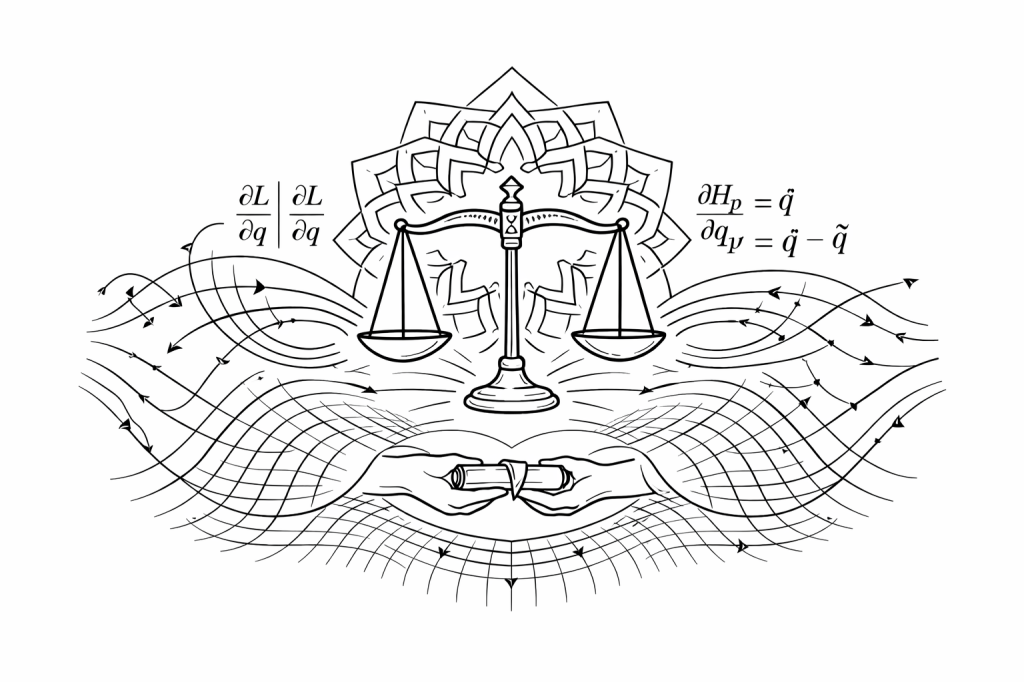
There is a theorem in the calculus of variations, proved in 1918 by a mathematician working on the energy problem in general relativity, that says, in effect, that nothing is conserved without reason. Energy persists because the laws of physics do not change from one moment to the next. Momentum persists because they do not change from one place to another. Angular momentum persists because they do not care which direction you face. Each of these conservation laws, which for two centuries were treated as independent empirical discoveries, turns out to be the necessary consequence of a single structural principle: if the equations governing a system remain unchanged under some continuous family of transformations, then there exists a corresponding quantity that the system cannot create or destroy but only redistribute. This is Noether’s theorem, and it is arguably the deepest single insight in mathematical physics.
I want to take this theorem seriously as a structural claim about how obligation behaves in Islamic law. The question is whether taklīf, the imposition of religious and legal obligation upon the mukallaf, exhibits conservation-like behaviour: whether obligation, like energy, is something that cannot be conjured into existence or annihilated by human action but only transferred between persons, redistributed across circumstances, or transformed in its specific character while its total quantity persists. And if it does exhibit such behaviour, the Noetherian framework demands a further question: what is the underlying symmetry, the invariance principle, whose existence necessitates that conservation? I will argue that the strongest candidate is the invariance of divine command under transformations of context, which is to say, the principle that the ḥukm remains fixed when the ʿilla is preserved even as the particular case changes. I will also argue that the analogy, precisely where it fails, reveals something important about the difference between physical and normative reality that neither physics nor jurisprudence, taken alone, can articulate.
I. The Theorem
Emmy Noether proved her results in a paper titled “Invariante Variationsprobleme,” presented to the Royal Society of Sciences at Göttingen on July 26, 1918, by Felix Klein on her behalf, since the faculty would not permit a woman to present in her own name. The immediate occasion was a crisis in general relativity. Einstein’s theory, published in 1915, appeared to violate energy conservation: because spacetime itself is dynamical, gravitational energy can exchange with matter energy in ways that resist formulation as a straightforward conservation law. Hilbert, who had arrived at the field equations independently, recognised that the problem was mathematical at root, and in 1916 he asked Noether, already an expert in invariant theory, to clarify the relationship between symmetry and conservation in variational problems. Her answer contained two theorems. The first, which is what people generally mean when they say “Noether’s theorem,” is the one relevant here.
The formal statement requires a few pieces of apparatus. A physical system is described by generalised coordinates q_i(t) and a Lagrangian L(q_i, q̇_i, t), where q̇_i denotes the time derivative. The action functional is S[q] = ∫ L dt, and the physical trajectory of the system is the one that makes S stationary, yielding the Euler-Lagrange equations of motion. A continuous transformation of the coordinates and time, parameterised by a small quantity ε, is a symmetry of the action if it changes the Lagrangian by at most a total time derivative. When this condition holds, there exists a quantity Q, constructed from the Lagrangian and the transformation, that satisfies dQ/dt = 0 along physical trajectories. Q is the Noether charge, and its constancy is the conservation law.
For field theories, the machinery generalises naturally. Fields φ(x) replace coordinates, the Lagrangian density ℒ replaces L, and the conserved object is a current j^μ satisfying the continuity equation ∂_μ j^μ = 0. The continuity equation is the crucial structure. It says that the density of the conserved quantity at any point changes only because of flow into or out of that point, not because it is being created or destroyed locally. Integrating the time component over all space gives the total conserved charge Q = ∫ j⁰ d³x, which is constant in time. The conservation is local and complete: the “stuff” described by the current neither appears from nothing nor vanishes into it.
The canonical examples are worth stating precisely because the essay will need to draw on them later. Invariance under spatial translation (the laws of physics are the same everywhere in space) yields conservation of linear momentum. Invariance under time translation (the laws do not change from one moment to the next) yields conservation of energy. Invariance under rotation (the laws do not prefer any spatial direction) yields conservation of angular momentum. In quantum field theory, the global phase symmetry of a complex field (ψ → e^{iα}ψ, with α constant) yields conservation of electric charge. In each case the pattern is the same: a continuous family of transformations that leaves the action invariant generates, by strict mathematical necessity, a quantity that the dynamics cannot alter.
Noether’s second theorem addresses a different situation entirely. When the action is invariant under transformations that depend on arbitrary functions of spacetime, which is to say local or gauge symmetries, where the transformation can vary from point to point (as opposed to the global symmetries that Noether’s first theorem addresses), the result is an identity among the equations of motion, which is a fundamentally different object from a conservation law: some of the equations are redundant, derivable from the others regardless of whether any physical trajectory is being considered. This is the mathematical expression of gauge redundancy, the fact that multiple descriptions correspond to the same physical state. It was Noether’s second theorem that resolved the energy crisis in general relativity: the diffeomorphism invariance of Einstein’s theory is a local symmetry, so the Bianchi identities (∇_μ G^{μν} = 0) hold automatically, and what looks like energy non-conservation is actually the absence of a global time-translation symmetry in curved spacetime. I mention the second theorem because the distinction between global and local symmetry will matter for the jurisprudential analogy: some forms of juristic disagreement may be “gauge,” describing the same normative reality in different scholarly idioms, while the genuine conservation of obligation arises from the global invariance of divine command itself.
One further distinction is essential. Noether’s theorem applies only to continuous symmetries, which is to say symmetries parameterised by a real-valued quantity that can be made arbitrarily small. Discrete symmetries, transformations that are all-or-nothing with no intermediate stages, do not fall under the theorem at all. The three fundamental discrete symmetries in particle physics are parity (spatial inversion), time reversal, and charge conjugation (swapping particles for antiparticles). These yield conserved quantum numbers of a different kind: multiplicative quantum numbers and selection rules, which have a fundamentally different mathematical character from the additive conserved charges generated by continuous symmetries. There is no “infinitesimal parity transformation” and therefore no derivative, no variational calculation, no Noether current. The distinction between continuous and discrete symmetry will become, I think, the most philosophically productive point of failure in the analogy with taklīf.
II. Spontaneous symmetry breaking
Before turning to jurisprudence, one more piece of physics requires attention, because it will do significant work in the argument. Spontaneous symmetry breaking occurs when the Lagrangian possesses a continuous symmetry but the ground state of the system does not. The laws are symmetric; the actual configuration of the world is not. When this happens, the Noether current remains exactly conserved and the Noether charge Q continues to satisfy dQ/dt = 0. However, Q does not annihilate the vacuum. The symmetry is real but hidden.
Goldstone’s theorem (1961) establishes the physical consequences: for every generator of a continuous global symmetry that is spontaneously broken, there exists a massless scalar excitation, a Nambu-Goldstone boson. The number of such bosons equals the number of broken generators. In ferromagnetism, the rotational symmetry of the Hamiltonian breaks below the Curie temperature as spins align along a particular direction, and the resulting Goldstone bosons are magnons, collective spin-wave excitations. In quantum chromodynamics, the approximate chiral symmetry of the light quarks is broken by the formation of a quark condensate, and the pions are the resulting pseudo-Goldstone bosons, not exactly massless because the symmetry was also explicitly (not just spontaneously) broken by the quark masses, but much lighter than they would otherwise be.
The distinction between types of symmetry breaking matters. Explicit breaking, where symmetry-violating terms appear in the Lagrangian itself, destroys the Noether current and the conservation law. Spontaneous breaking preserves the conservation law at the level of the equations while the actual state of the system selects a non-symmetric configuration. Each type, I will argue, has a jurisprudential analogue.
III. Taklīf and its conditions
Taklīf, from the root k-l-f, to impose a burden, refers in uṣūl al-fiqh to the imposition of legal and religious obligation by God upon the legally competent person. The mukallaf, the one upon whom taklīf is imposed, must satisfy conditions on which there is near-universal agreement across all schools: bulūgh (physical maturity), ʿaql (sound reason), knowledge of the obligation, capacity to perform it, and freedom to choose obedience or disobedience. Children, the insane, and the coerced are not mukallaf, though what precisely happens to the obligation in their case, whether it is suspended, extinguished, or transformed, will be important for the conservation question.
The conditions are not arbitrary. They identify the features of a person that render obligation intelligible, the features in whose absence it would be incoherent to speak of a command at all. One cannot meaningfully command an infant, because the structure of command requires an addressee capable of understanding and response. The conditions for taklīf, in other words, are logical preconditions for the very concept of obligation, which means the “removal” of taklīf from those who fail to meet the conditions is analogous to a situation in which the conservation law is inapplicable in the first place, like asking about the momentum of a point that does not exist.
Every human act, according to all schools, falls under one of five normative categories, the aḥkām al-khamsa: wājib (obligatory), mustaḥabb (recommended), mubāḥ (permissible), makrūh (disliked), and ḥarām (forbidden). Murtaḍā Muṭahharī puts the point as a completeness claim: in the view of Islam no action is empty of one of these five rulings. The taxonomy is exhaustive and the categories are mutually exclusive. No act floats free of normative assessment. This is a structural feature worth pausing over, because it means the normative “field” is everywhere nonzero; there is no region of human action that lies outside the scope of the Sharīʿa’s evaluation. One might say, using the physics loosely but not, I think, misleadingly, that every act carries normative charge.
The Ḥanafī school introduces a refinement that adds internal complexity without disturbing the overall structure: it distinguishes farḍ (established by definitive evidence) from wājib (established by probabilistic evidence), and makrūh taḥrīmī (prohibitively disliked, approaching ḥarām) from makrūh tanzīhī (mildly disliked). This subdivision within categories is important for the continuous/discrete question. The five categories are discrete, but the distinctions within them suggest something like a finer normative gradation, a spectrum partially visible through the coarse grid of the five-fold classification.
IV. The metaphysics of the command: who conserves obligation and why
The deepest disagreement in Islamic kalām about the nature of obligation runs between the Muʿtazila and the Ashāʿira, and it maps, with unexpected precision, onto a disagreement about the nature of symmetry in physics.
The Muʿtazilī position, developed most systematically by Qāḍī ʿAbd al-Jabbār al-Hamadhānī in his twenty-volume al-Mughnī and his Kitāb al-Majmūʿ fī-l-Muḥīṭ bi-l-Taklīf, holds that actions possess intrinsic moral properties. Truthfulness is good and lying is evil because their moral character inheres in their nature, independent of divine declaration. Human reason can discern these properties independently of revelation, because the moral order is objective and rationally accessible. God commands what is good because it is good; His will tracks the moral order, which exists prior to and independent of the command. Revelation is necessary for the specification of particular duties (the precise form of the ṣalāt, the detailed rules of inheritance), but the general moral framework (prohibition of injustice, obligation of gratitude to benefactors) is available to reason prior to and independently of prophetic communication.
The Ashʿarī counter-position holds that actions possess no intrinsic moral properties whatsoever. An act is good if God commands it and evil if God forbids it. Obligation is constituted entirely by divine decree. Before revelation, there is no obligation; reason alone cannot generate duties. Al-Ghazālī sharpened this into a claim about the unreliability of human moral cognition: our sense that certain things are inherently right or wrong reflects habit, social conditioning, and the limitations of finite intellects, and has no purchase on an independent moral order. What is sometimes called the Islamic Euthyphro dilemma finds its two horns here: the Muʿtazilī position that God commands the good because it is good, and the Ashʿarī position that the good is good because God commands it.
The Māturīdī school stakes out a position that resists collapse into either alternative, and for that reason it complicates the analogy in productive ways. With the Muʿtazila, al-Māturīdī agrees that reason can independently recognise good and evil, that moral properties are in some sense real and accessible to the intellect. With the Ashāʿira, he agrees that formal legal obligation requires revelation, that reason alone is insufficient to ground binding duties. The result is a two-source epistemology: reason and revelation reinforce one another, each covering what the other cannot. Whether this constitutes a genuine synthesis or an unstable compromise is debated, but its structural interest for the present argument is clear: it suggests that the “symmetry” grounding obligation may be neither purely rational nor purely volitional but something that requires both.
Now, the Jaʿfarī position. Shīʿī uṣūl al-fiqh, in its Uṣūlī form, which has been dominant since Vaḥīd al-Bihbahānī’s decisive defeat of the Akhbārī school in the eighteenth century, accepts four sources of law: Qurʾān, Sunna (understood to include the teachings of the Twelve Imams), ijmāʿ (consensus, interpreted more narrowly than in Sunnī jurisprudence), and ʿaql (reason). The inclusion of ʿaql as a formal source is not incidental; it follows from the Shīʿī alignment with Muʿtazilī moral epistemology. The Shīʿa, alongside the Muʿtazila, are classified as the ʿAdliyya, those who affirm that moral values are objective and rationally discernible, that ḥusn and qubḥ are ʿaqlī, accessible to reason independently of revelation. This shared commitment to rational ethics is precisely what gives ʿaql its authority as a source: if moral truth is accessible to reason, then reason can function as an independent ground of legal knowledge.
The Akhbārī challenge, associated with Muḥammad Amīn al-Astarābādī and his followers, rejected ʿaql and ijmāʿ as independent sources, held that virtually all ḥadīth in the Four Books were reliable, and applied iḥtiyāṭ (precaution) in cases of doubt, where the Uṣūlīs would apply barāʾa (presumption of permissibility). The Uṣūlī response, which prevailed, insisted on the critical evaluation of ḥadīth, the necessity of independent rational inquiry, and the legitimacy of ijtihād by qualified mujtahids. For the present argument, the Uṣūlī victory matters because it preserves the rational ground of obligation. If the Akhbārī position had prevailed, the “symmetry” generating the conservation of taklīf would reduce to textual fidelity alone, a narrower and more fragile basis.
Ākhūnd Muḥammad Kāẓim al-Khurāsānī’s Kifāyat al-Uṣūl, the capstone text of advanced Shīʿī legal methodology, treats both verbal proofs (al-adilla al-lafẓiyya) and rational proofs (al-adilla al-ʿaqliyya). The architecture of the work itself reflects the dual epistemic basis of Shīʿī jurisprudence: textual evidence and rational demonstration function as complementary, mutually reinforcing sources of normative knowledge. Muḥammad Bāqir al-Ṣadr’s Durūs fī ʿIlm al-Uṣūl pushed further, proposing the theory of ḥaqq al-ṭāʿa (the right to obedience) as a grounding for obligation and developing a distinctive account of how practical knowledge is generated. Al-Ṣadr’s broader intellectual project, spanning economics, logic, and philosophy alongside jurisprudence, exemplifies the integration of rational inquiry into the fabric of Shīʿī thought in ways that make the Noether analogy not merely possible but, I think, natural.
V. Qiyās as symmetry operation
Qiyās, analogical reasoning from a case with an established ruling to a new case sharing the same effective cause, has four pillars: the aṣl (original case), the farʿ (new case), the ʿilla (effective cause or ratio legis), and the ḥukm (ruling). The Qurʾān prohibits wine; the ʿilla is identified as intoxication; by qiyās, the prohibition extends to all substances sharing that property. The ruling is conserved under the transformation from one case to another, provided the ʿilla is preserved. This is, structurally, a symmetry operation in the sense relevant to Noether’s theorem. The “action” of the legal system (the complete set of divine rulings for all possible human acts) remains invariant under the “transformation” that maps one ʿilla-bearing case to another. The ḥukm is the conserved charge.
The conditions for valid qiyās mirror, with suggestive precision, the conditions for a valid symmetry. The ʿilla must be munḍabiṭ (constant, precisely identifiable), which is to say it must function like a well-defined generator of the transformation. It must be munāsib (bearing a rational connection to the ruling), which corresponds to the requirement that the symmetry relate to the actual structure of the Lagrangian and not be merely an accidental feature of a particular solution. It must not contradict textual authorities, preserving the “Lagrangian” itself. And the original case must have a clear, established ruling, because a symmetry transformation that acts on an undefined state produces nothing meaningful.
The three methods of identifying the ʿilla refine this further. Tanqīḥ al-manāṭ, the refinement of the ratio legis, strips away irrelevant features to isolate the operative cause. This is precisely what a physicist does when identifying the symmetry of a system: one removes the accidental features of a particular configuration to reveal the underlying invariance. Takhrīj al-manāṭ uses elimination and division to test candidate causes, analogous to testing which transformations leave the action invariant. Taḥqīq al-manāṭ verifies that the ʿilla is actually present in the new case, corresponding to confirming that the symmetry transformation is well-defined at the point where one wishes to apply it.
The cross-school differences on qiyās introduce important qualifications. The Ḥanafīs apply qiyās most liberally but also accept istiḥsān, juristic preference, as a corrective when strict analogical reasoning produces unjust results. One might read istiḥsān as an acknowledgment that the symmetry sometimes breaks down, that the transformation from one case to another, even when the ʿilla appears to be preserved, can fail to conserve the deeper normative purpose. The Mālikīs supplement qiyās with istiṣlāḥ, the consideration of public interest, which introduces an additional invariance principle (the welfare of the community) alongside the ʿilla-based symmetry. The Shāfiʿīs, who systematised qiyās in al-Shāfiʿī’s al-Risāla, reject istiḥsān on the grounds that it introduces subjective judgment where the method should be rigorous. The Shīʿa reject formal qiyās altogether while accepting tanqīḥ al-manāṭ, the refinement method, within the broader framework of ʿaql. The rejection of qiyās by the Jaʿfarī school does not, however, amount to a rejection of the symmetry principle it embodies. The particular formalism is refused, the claim that analogical extension from case to case is a reliable method, but the deeper principle that rulings must be rationally grounded and that the identification of operative causes is a legitimate intellectual activity survives intact through ʿaql and tanqīḥ al-manāṭ. The Shīʿī position is, one might say, sceptical of a particular symmetry operation while affirming the invariance principle that would justify it.
VI. Conservation of taklīf
With the physics and the jurisprudence in hand, I can now state the central claim precisely. Taklīf, considered as a property of the normative order as a whole, at the level of the system and not of any individual person, exhibits conservation-like behaviour in the following sense: the total obligatoriness imposed by the Sharīʿa upon the community of the mukallafīn is neither created nor destroyed by human action but only redistributed across persons and circumstances.
The evidence for this claim runs through several distinct mechanisms.
First, the rukhṣa/ʿazīma structure. When a traveller is excused from fasting during Ramaḍān, the obligation does not vanish. It transforms into a qadāʾ obligation, a debt of fasting to be discharged after the journey, or in some cases into a fidyah, a compensatory act of a different kind. The strict ruling (ʿazīma) remains operative in principle; the concession (rukhṣa) is a temporary displacement of the obligation in time or form, not its abrogation. When the excusing circumstance passes, the original form of the obligation resumes. The total normative weight has not changed; it has been rescheduled.
Second, farḍ kifāya, collective obligation. The obligation to perform the funeral prayer, to pursue certain forms of knowledge, to defend the community, falls on the umma as a whole. If a sufficient number fulfil it, the rest are relieved. But if no one fulfils it, the entire community bears the sin. The obligation has not been divided among individuals, with each carrying a fraction; it rests on the collective as a whole and is discharged by any adequate subset. One might describe this as the obligation being “delocalised,” spread across the community without being concentrated in particular persons, in a way that mirrors how a conserved charge can be distributed across a field configuration without being concentrated at any single point. The total charge is fixed; its spatial distribution is variable.
Third, the completeness of the five rulings. If every act carries normative charge, and the taxonomy is exhaustive, then the normative field has no gaps. There is no action one can perform that lies outside the scope of assessment. This closure of the normative system is a precondition for conservation: in physics, a conserved quantity can only be conserved within a closed system, one from which nothing leaks and into which nothing enters from outside. The claim that the Sharīʿa evaluates every conceivable human action is the claim that the normative system is closed.
Fourth, the persistence of obligation across the conditions of taklīf. When someone falls asleep, obligation is suspended, but missed prayers are owed upon waking. When someone loses and then regains sanity, the question of what must be made up is debated, but the default assumption across most schools is that the obligation persists in some form even when the conditions for its active application are not met. The analogy in physics is to a conserved charge in a region where the field configuration temporarily prevents its manifestation, like electric charge on a conductor whose geometry temporarily screens it from measurement. The charge is still there; it simply cannot be observed until conditions change.
The question Noether’s theorem forces upon this picture is: what is the symmetry that generates this conservation? I argued above that the strongest candidate is the invariance of divine command under transformations of context. The ḥukm does not change when the ʿilla is preserved across cases. The Sharīʿa is eternal and unchanging; fiqh is the variable, historically situated human effort to discern and apply it. The apparent variability of rulings reflects the discovery that different principles apply when circumstances change, while the underlying law itself remains fixed. Ibn al-Qayyim captured this with precision when he wrote that any ruling that replaces justice with injustice, mercy with its opposite, or wisdom with foolishness is not part of the Sharīʿa even if some interpretation claims it is. The invariant is the normative purpose itself: justice, welfare, wisdom. Specific rulings are the solutions; the maqāṣid are the equations.
Now, the Muʿtazilī and Ashʿarī positions offer fundamentally different accounts of what grounds this invariance, and the difference maps onto a deep question in the philosophy of physics. For the Muʿtazila and the ʿAdliyya more broadly, the invariance arises from the rational structure of moral reality itself. Moral properties inhere in acts objectively; God commands what is good because it is good. The symmetry, in Noetherian terms, is a feature of the moral landscape, built into the nature of things independent of anyone’s will. This is structurally identical to the physicist’s view that symmetries are features of nature that the laws must respect. Energy is conserved because time-translation symmetry is a genuine feature of the physical world, prior to and independent of any observer’s will.
For the Ashāʿira, the invariance is the constancy of God’s will. Obligation does not change because God does not change His mind. The “symmetry” is volitional, grounded in the constancy of divine will, with no further structural substrate beneath it. This corresponds to the pre-Noether view of conservation laws as brute empirical facts without deeper explanation. Energy is conserved, and that is simply how things are. One might even say that the Noetherian revolution in physics recapitulates, in its explanatory structure, the Muʿtazilī revolution in kalām: both insist on asking what lies behind the conservation, what deeper invariance principle generates the surface-level persistence, when it would be simpler to accept the persistence as primitive.
The Shīʿa, positioned within the ʿAdliyya but enriched by the institution of wilāya, add a further structural element. Wilāya is the chain of authority through which divine obligation is transmitted across history: God to the Prophet, the Prophet to the Imams, the Imams to the fuqahāʾ during the Greater Occultation. This chain functions as the mechanism that conserves obligation through time, analogous to the way the continuity equation ∂_μ j^μ = 0 ensures that the conserved quantity at each point changes only through flow, never through creation or destruction. The obligation “flows” along the chain of wilāya, maintained and interpreted by each link but never augmented or diminished. The mujtahid’s function is discernment and transmission, and the marjaʿ’s authority is fundamentally conservational: the obligation they handle precedes them and will survive them.
VII. Spontaneous symmetry breaking and the Sharīʿa/fiqh distinction
The distinction between Sharīʿa and fiqh, which I take to be one of the most important conceptual distinctions in Islamic legal thought, finds a natural and non-trivial structural analogue in spontaneous symmetry breaking.
The Sharīʿa, understood as the totality of God’s normative will for human action, is the “symmetric Lagrangian.” It possesses the full invariance: eternal, unchanging, impartial, rationally structured according to the maqāṣid. But fiqh, the human effort to extract, interpret, and apply rulings from the divine sources, is the “ground state.” It is a particular, historically situated, inevitably partial realisation of the Sharīʿa’s content. And like the ground state in physics, it necessarily breaks the symmetry of the Lagrangian. The Sharīʿa does not prefer any particular school of law, but actual legal practice always takes the form of one madhhab or another. The Sharīʿa does not prefer any particular era, but actual rulings are always issued in specific historical circumstances.
The different madhāhib, in this reading, are different ground states of the same symmetric system. Each breaks the symmetry differently, emphasising different methods, arriving at different specific rulings on contested questions, while all (if they are legitimate ijtihād) conserve the underlying maqāṣid. The Ḥanafī emphasis on istiḥsān, the Mālikī reliance on ʿamal ahl al-Madīna, the Shāfiʿī systematisation of qiyās, the Ḥanbalī textualism, the Jaʿfarī integration of ʿaql: these are different orientations of the “order parameter,” different ways in which the full symmetry of divine command crystallises into specific legal practice.
Goldstone’s theorem predicts that when a continuous global symmetry is spontaneously broken, massless excitations appear. The suggestive analogue is this: when the universal symmetry of the Sharīʿa is “broken” by application to specific contexts through ijtihād, derivative rulings emerge, new normative content that did not exist at the level of explicit text but is generated by the interaction between eternal principle and contingent circumstance. These derivative rulings are the Goldstone bosons of the legal system, so to speak: light, numerous, emergent, and directly traceable to the fact that the full symmetry is present in the underlying law but absent from any particular realisation of it.
I do not wish to press the Goldstone analogy beyond its capacity. It is suggestive, and the mathematical conditions for Goldstone’s theorem (continuous global symmetry, spontaneous breaking, Lorentz invariance of the underlying theory) have no exact jurisprudential counterparts, which means the analogy should be handled with caution. But the structural intuition it encodes, that the gap between an underlying symmetric principle and its asymmetric realisation generates new content, is I think genuine and illuminating.
VIII. Where the analogy fractures
Noether’s theorem requires continuous symmetry. The five aḥkām are discrete categories. This is not a difficulty that can be finessed or set aside. It goes to the mathematical foundation of the theorem: the proof constructs the conserved current by differentiating the Lagrangian with respect to a continuous parameter, and if no continuous parameter exists, the construction fails. Discrete symmetries in physics, as I noted above, yield multiplicative quantum numbers and selection rules, which belong to a fundamentally different mathematical species from additive conserved charges. There is no Noether current for parity.
Several responses suggest themselves, and I want to work through them with some care because I think the most interesting claims of the essay lie here, at the point of failure.
The first response is that the discreteness of the five rulings is epistemic, a feature of our categories and not of the underlying normative reality. The underlying normative reality may be continuous. There are, after all, degrees within each category: varying levels of emphasis among wājib acts, gradations of dislike among makrūh ones, the Ḥanafī subdivision of both farḍ/wājib and makrūh taḥrīmī/tanzīhī suggesting that the five-fold classification is a coarse-graining of a more finely grained normative field. One might argue that the discreteness is an artefact of the human need for categorical clarity in practical guidance, not a feature of the divine will itself. God, on this view, evaluates acts along a continuum; human legal categories approximate this continuum with a manageable set of discrete labels. This parallels how macroscopic discrete states (ice, water, steam) emerge from underlying continuous thermodynamics, or how the discrete energy levels of an atom arise from the continuous Schrödinger equation subject to boundary conditions.
This response has force, but it also has limits. The five rulings correspond to distinct deontic modalities (obligatory, forbidden, permissible) that appear to be genuinely categorical. The difference between wājib and mustaḥabb is a difference of kind: wājib carries the threat of punishment for omission; mustaḥabb does not. One can move smoothly between energy values in a classical system, but one cannot smoothly interpolate between “punishable omission” and “praiseworthy but unpunished commission.” The discreteness appears to be structural.
The second response reframes the analogy entirely. If the five aḥkām are genuinely discrete, then perhaps they correspond to selection rules, which is the kind of constraint that discrete symmetries actually generate in physics. In physics, discrete symmetries yield selection rules: this transition is allowed, that one is forbidden. Parity conservation (when it holds) forbids transitions between states of opposite parity. The five normative categories function similarly: they classify which actions are permitted and which are forbidden, which transitions between normative states are possible. The movement of an act from mubāḥ to ḥarām requires a specific juristic rationale (a new textual indication, a changed ʿilla); not all such movements are permissible, and the constraints on which movements can occur are, in effect, selection rules.
This reframing is more modest than the conservation-law reading, but it may be more precise. It preserves the core insight that normative constraints are generated by invariance principles while acknowledging that the mathematical character of the constraints differs from what Noether’s theorem strictly yields. It is, I think, the honest position: the analogy with Noether’s theorem is structural and illuminating but not exact, and the point at which it ceases to be exact, the continuous/discrete boundary, is itself the most informative feature of the comparison.
The third response, which is the one I find most compelling, takes the fracture as the essay’s central philosophical finding. The fact that obligation operates through discrete categories while physical conservation operates through continuous quantities reveals something about the ontological difference between normative and physical reality that neither domain, taken alone, can articulate. Physical law is continuously variable because the physical world is indifferent to boundaries of kind: energy flows smoothly, momentum transfers incrementally, charge distributes continuously across fields. Normative law operates through categorical judgments because it addresses agents, and agents require clarity about what they are and are not permitted to do. The mukallaf needs to know whether an act is ḥarām or makrūh; the answer “it is −1.7 on the normative scale” is useless for practical guidance.
The point here is a specific one about agency. The normative world is irreducibly agentive in a way the physical world is not. Conservation in physics requires no interpreter. The total energy of an isolated system remains constant regardless of whether anyone observes it, calculates it, or cares about it. Conservation of obligation, if that is what the persistence of taklīf amounts to, requires an unbroken chain of authoritative interpretation: wilāya, the transmission of authority from God through the Prophet and the Imams to the fuqahāʾ. Without this chain, the obligation does not cease to exist in principle, but it becomes practically inaccessible, like a conserved charge whose field configuration has become unmeasurable. The institution of taqlīd, the obligation of laypeople to follow a living mujtahid, is the social mechanism by which the conservation of obligation is made practically operative: it ensures that the “measurement” of normative charge, the determination of what is obligatory in a given circumstance, is always being performed by someone qualified to perform it.
This, I think, is what the failure of the Noether analogy at the continuous/discrete boundary ultimately shows. Normative reality shares with physical reality the property that what persists does so because something deeper remains invariant. But normative reality adds a requirement that physical reality does not: it must be interpreted, transmitted, and applied by rational agents operating within structures of authority. The conservation of obligation requires institutions, intellectual traditions, chains of scholarly authority, in a way that the conservation of energy simply does not. When these break down, when the chain of wilāya is disrupted or the tradition of ijtihād is abandoned, the conservation of obligation is compromised because the mechanism of its enforcement has failed, even as the underlying symmetry persists. The Sharīʿa remains symmetric; it is the human capacity to discern and apply its content that is fragile.
IX. What kind of analogy is this?
I have been careful throughout to say “structural analogy” and “structural correspondence,” and the precision matters. Noether’s theorem identifies a structural relationship, the link between invariance and conservation, that appears across multiple domains, and Islamic jurisprudence is one such domain. The relationship is not exact: the analogy breaks at the continuous/discrete boundary, and the mechanisms of conservation differ fundamentally (differential equations in physics; chains of authority and interpretive tradition in jurisprudence). But the structural pattern, that what persists does so because something deeper remains invariant, and that the character of the invariance determines the character of the persistence, is genuine in both domains.
This kind of cross-domain structural reasoning is not without precedent. It is, in a sense, what the Muʿtazila were doing when they argued that the same rational principles governing the natural world also govern the moral world, that both are subject to rational intelligibility of the same fundamental kind. The Muʿtazilī commitment to ḥusn wa qubḥ ʿaqlī is a commitment to the view that the moral order is as structurally principled as the physical order, susceptible to the same kinds of analysis, yielding to the same demand for underlying reasons. The present essay extends that commitment into a specific formal territory: the territory of symmetry and conservation.
The Ashʿarī objection to this entire enterprise is predictable and, in its own terms, coherent. If obligation is constituted entirely by divine command, then the “symmetry” behind the conservation of taklīf is nothing other than the constancy of God’s will, a theological datum that resists further structural analysis. On this view, the Noether analogy is vacuous: it just restates the truism that God does not change His mind. I take this objection seriously, but I think it underestimates the structural content of the analogy. Even on Ashʿarī premises, the pattern of how obligation is conserved, through farḍ kifāya, rukhṣa, qadāʾ, the chain of wilāya, reveals something about the internal logic of the normative order that the bare assertion “God wills it” does not. The mechanisms of conservation are informative regardless of what one takes to be their ultimate ground.
Moreover, there is a sense in which the Ashʿarī position is precisely the pre-Noetherian position in physics. Before 1918, conservation of energy was taken as a brute fact about the world. After Noether, it was understood as a consequence of time-translation symmetry, and this understanding constituted a genuine explanatory advance that enabled new predictions (where symmetries are broken, conservation fails; where new symmetries exist, new conservation laws follow). The Muʿtazilī and Jaʿfarī insistence on ʿaql as a source of law performs an analogous function: it insists on asking what rational structure underlies the persistence of obligation, and in doing so it enables a deeper understanding of why the obligation has the specific character it does. The Ashʿarī position is, from this vantage, correct as far as it goes and incomplete in what it leaves unasked.
X. Gauge freedom and legitimate ikhtilāf
One final observation, which I offer more tentatively because the physics is subtle and the jurisprudential implications are far-reaching. Noether’s second theorem tells us that gauge symmetries, local symmetries depending on arbitrary functions, generate identity relations and redundancies in description, which are fundamentally different objects from conservation laws. The distinction between gauge symmetry and global symmetry is the distinction between different ways of saying the same thing and genuinely different things being the same.
Legitimate ikhtilāf, the permissible disagreement among qualified mujtahids on contested questions of fiqh, may be “gauge” in this sense. Different scholars, applying different but legitimate methods to the same sources, arrive at different specific rulings that are nonetheless descriptions of the same underlying normative reality. The principle that all sincere mujtahids are rewarded even when they err, because the truth in matters of ijtihād is one but the approaches are many, has the structure of gauge equivalence: multiple formally distinct descriptions, one physical (normative) reality.
If this is right, then the genuine conservation laws of the normative system arise from the invariance of divine command itself, the global symmetry, while the diversity of scholarly opinion constitutes something closer to gauge freedom. The proliferation of madhāhib, the diversity of fatwā, the historical variation in legal practice: these are the gauge degrees of freedom of Islamic law, legitimate redundancies in how the single underlying truth is expressed. The conserved quantity, taklīf itself, is invariant under the deeper symmetry that the Sharīʿa’s normative content does not change even as its human expression varies endlessly; the transformations between scholarly opinions are something else entirely, degrees of freedom in how the truth is formulated.
Whether this reading is correct, whether the diversity of legitimate opinion in Islamic law is genuinely analogous to gauge redundancy or instead reflects a real multiplicity in the normative facts themselves, is a question I cannot settle here. It depends on whether one believes, with the mainstream of uṣūl al-fiqh, that every question has a single correct answer known to God even if humans cannot determine it with certainty (which supports the gauge reading), or whether one believes that legitimate plurality has ontological weight of its own (which would make the diversity a physical difference, something more than a gauge artefact). I raise it because the Noetherian framework, taken seriously, generates questions about Islamic legal metaphysics that are both precise and nontrivial.
What began as a question about whether obligation is conserved has ended, as I think it should, as a question about what kind of thing the normative order is. The analogy with Noether’s theorem illuminates the structure of jurisprudence by holding it up against a formal framework in which the relationship between invariance and conservation is made maximally explicit, and then attending carefully to where the illumination holds and where it does not. The structural correspondences, qiyās as symmetry operation, the Sharīʿa/fiqh distinction as spontaneous symmetry breaking, wilāya as the conservation-enforcing transmission chain, are real and, I think, original. The failure of the analogy at the continuous/discrete boundary is equally real and equally important: it shows that normative reality is irreducibly agentive, categorical, and authority-dependent in ways that physical reality is not. Both the correspondences and the failure tell us something we did not know before, which is, in the end, what an analogy is for.
Selected Bibliography and Readings below




 Paimana
Leave a comment