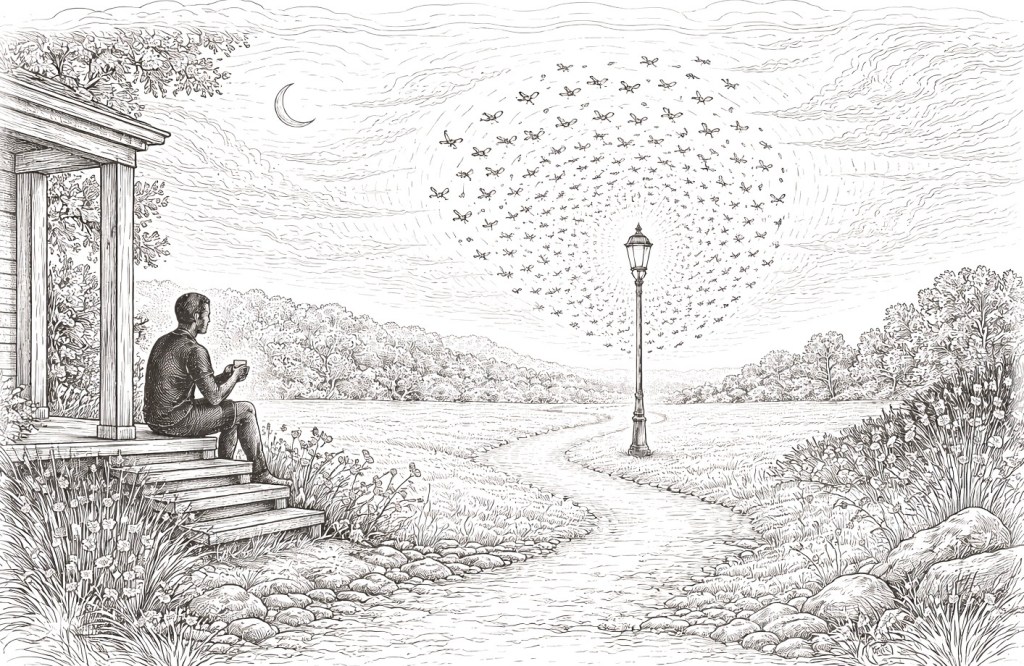
There is an hour, just after the streetlights come on but before the night has fully settled, when the moths appear. I first noticed this on a Tuesday in late August, standing on the porch with a cup of tea that had gone cold. One moth, then several, then what could only be described as a congregation of them around the yellow lamp at the end of the walk. They did not appear to be traveling. They were not, as far as I could tell, engaged in any activity that would be legible as purposeful from the outside. They were simply present, oriented toward the light with a consistency that I found, over the course of what turned out to be a long stretch of watching, increasingly difficult to dismiss as mere behavior.
I stayed longer than I had intended. This is worth noting because I have spent most of my adult life doing the opposite: converting experience into material almost reflexively, filing moments as memories or metaphors or things to mention later, which is to say converting them into something other than what they are in the act of encountering them. That evening I did not do this. I watched without converting, and the watching itself, rather than anything I observed, is where this essay begins. Not because what I saw was remarkable, but because the decision to remain inside an experience without immediately processing it into a transferable form turned out to be, for reasons I did not fully understand at the time, the first honest thing I had done in months.
· · ·
Some months ago I was watching a documentary on Farid Ayaz, the Pakistani qawwal, in which he narrated a story I have not been able to set aside since. It is an old Sufi tale, the kind that moves through generations without a fixed author, accumulating interpretive weight with each retelling in a manner not unlike what Rao, Shulman, and Subrahmanyam describe in their work on South Asian historical narrative: a story that does not simply record but actively generates meaning, each iteration depositing something the previous teller may not have intended but could not have prevented.
The flies, the story goes, had grown tired of being called flies. They looked at the moths and could not identify a meaningful distinction. Both had wings. Both flew. Both moved through the same air toward the same darkness. So they went to the king of the moths and demanded that the classification be revised. We are the same as you, they said. On what basis are we treated as lesser?
The king said the answer was simple, and that the evening would provide it. When dusk came, he sent them all, flies and moths together, in search of light. The flies went readily into the village where the lamps were burning. They located the light. They noted its position and its qualities. They assessed it from what might be called a prudent distance. And then they returned.
Now call us moths, the flies said. We found the light and we are here to report on it.
The king looked around at what remained of the assembly. Only the flies had come back. He was quiet for a moment. One of the flies, irritated by the pause, pressed him for a ruling.
If you found the light, the king said, why did you have to come back?
The flies had observed the light. The moths had entered it. The distinction the flies had assumed to be nominal turned out to be, in a quite precise sense, ontological.
I have returned to this story repeatedly, not only as a spiritual proposition, though it functions as one, but as what might be more accurately described as a diagnostic framework: a way of identifying two fundamentally different orientations toward experience, the distance between which is not a distance of degree but of kind. The fly’s relationship to the light is observational. The moth’s relationship to the light is constitutive. These are not two points on a spectrum. They are two different activities altogether.
· · ·
The entomological explanation is worth pausing over, not because it resolves the parable but because it complicates it in a productive direction. A moth navigates by maintaining a light source at a fixed angle to its body. When that source is the moon, which is distant enough to function as a point at infinity, the geometry holds and the moth travels in a straight line. A nearby lamp, however, is not the moon. The angle shifts with each wingbeat, and to maintain constancy the moth must curve inward, tightening its spiral toward the source in an arc that appears, from the outside, to be confusion or compulsion. It is neither. The moth is executing the same navigational principle it has always executed, with total fidelity. The difference is simply that when the light source is proximate rather than distant, that fidelity terminates in the flame.
This is generally treated as a design flaw, an evolutionary miscalculation, a ready-made metaphor for obsession. What interests me, however, is something else: the image of a creature so completely organized around a single orienting principle that no alternative geometry is available to it. We claim to value that kind of singular commitment. We build philosophies around it, spiritual disciplines, entire lives. And then, in practice, most of the time, we do what the flies did. We locate the light. We note its position and its qualities. We go home and report on it.
· · ·
I grew up inside a tradition that treated the unseen not as a speculative category but as a dimension of reality that demanded, and rewarded, sustained attentiveness. The household was Shi’i Muslim, which meant a particular theological inheritance: one shaped not only by submission but by longing, organized around the conviction that there exists a living axis between the human and the divine, and that the central task of a life is to orient oneself toward that axis with whatever fidelity one can manage. Over years of study, the sectarian architecture of this tradition fell away for me, not through any dramatic crisis of faith but gradually, through the ordinary process of reading more widely and thinking more carefully. I came to understand the early imams as extraordinary scholars and moral thinkers rather than divinely appointed intermediaries. I came to see the original split for what it was prior to centuries of doctrinal elaboration: a political fracture, contingent and human in its origins, hardened over time into something that presented itself as theology.
What did not fall away, and what I have by now stopped attempting to discard, is the affective core of that inheritance. By this I do not mean the doctrinal content but rather the orientation itself: the sense that proximity to the sacred is not primarily a matter of holding correct propositions but of cultivating a quality of attention so thorough that the distinction between the one attending and the thing attended to becomes, at certain moments, difficult to maintain. One can stand before something holy and observe it with considerable care, catalogue its features, and return home with a detailed and accurate account of what one witnessed, entirely unchanged by the encounter. Or one can stand there and allow it to be costly. The Sufi tradition within Islam understood this distinction with a precision I have not encountered in quite the same form elsewhere. The reed flute in the opening of Rumi’s Masnavi does not describe separation from the divine; it enacts that separation, sounding from a depth of longing such that the distinction between the cry and what it reaches for ceases to be analytically useful. The mystics in that lineage were not interested in producing knowledge about God in the way that one produces knowledge about a distant object of study. They sought what the parable describes: entry into the light rather than a report on it, a dissolution so complete that the question of return becomes incoherent.
I should be clear that I am not a mystic, and the clarification matters because what follows could easily be mistaken for a claim to mystical experience, which it is not. But I was formed by people who took mysticism seriously, who performed their prayers in a language that was not their mother tongue and meant every word, who sustained in the household a particular quality of devotional attention in the way that other households sustain a commitment to punctuality or academic achievement. It was simply part of the environment. The consequence is that when I watch moths orient toward a porch lamp on a late August evening, I cannot restrict what I am seeing to its entomological dimensions. The image carries, for me, an associative weight that precedes and exceeds any biological explanation, a weight deposited by a tradition I did not choose and have not been able to fully set down.
· · ·
The summer I was most isolated, living in a sublet between one arrangement and the next, I developed the habit of sitting outside after dark. I mention this not to establish atmosphere but because the practice itself is relevant to the argument. I was not reading. I was not listening to anything. I was engaged in what can only be described as unstructured attention, which is to say attention directed at nothing in particular and therefore, in a sense, directed at everything: the quality of the air, the incremental quieting of the neighborhood, the moths at the lamp above the door.
I was afraid that summer in ways I would not have been able to specify if pressed, which is itself part of what I am describing. The fear was not of any identifiable threat but of something more diffuse: the possibility that certain decisions I had made were more permanent in their consequences than I had understood, the weight of a silence I had not chosen and did not know how to end. I sat outside anyway. The moths were engaged in their activity regardless of my state of mind, which was precisely the point. What I needed, though I would not have put it this way at the time, was proximity to something that operated entirely without reference to my uncertainty, something incapable of the specifically human act of evaluating you and finding you insufficient.
There is, in the tradition I come from, a practice of attention so complete that the boundary of the self temporarily dissolves into what it attends to, not metaphorically but as a description of what the practitioner undergoes. The mystics cultivated this the way a musician works toward a passage practiced a thousand times, through sustained repetition and failure, until the distance between performer and material collapses and the notes cease to be something played and become something inhabited. I am not claiming to have achieved anything resembling this on a dark porch in August. What I am suggesting, more modestly, is that I was engaged in its most preliminary form, which consists of nothing more complex than ceasing to perform the activity of observation and instead being located within it. Ceasing, in the terms of the parable, to be the fly.
· · ·
There is a framework for understanding reality that I find myself returning to with increasing regularity, one that began as a proposition encountered in a graduate seminar and has since become something that operates less like an intellectual position and more like a conviction, or perhaps like the infrastructure on which a conviction might eventually rest. The framework, stated simply, is this: the world is not composed, at its most fundamental level, of things but of events. Not substances but processes. Each event gathers into itself the entirety of what preceded it, presses into the present with the weight of that accumulation, and then releases forward into whatever follows. What we experience as stable objects, including what we experience as stable selves, are better understood as processes whose continuity is real but whose permanence is not.
This is not a mystical claim, though it arrives at territory the mystics have inhabited for centuries through entirely different routes. It is closer to what sustained philosophical engagement with the nature of time and process has been articulating since at least Whitehead, and arguably since Heraclitus, though the contemporary version owes more to physics than to pre-Socratic metaphysics. The electron does not persist unchanged between observations. The cell that replaces another cell is not that cell. The person who finishes reading this sentence is not, in any rigorous sense, identical to the person who began it, though the difference is of a scale that consciousness routinely elides in the interest of maintaining the narrative of continuity on which its operation depends.
What I find compelling about this framework, what draws me back to it well after the seminar has ended and the assigned reading has been shelved, is what it implies about loss, and specifically about those periods of apparent inactivity that punctuate a life and appear, from the inside, to produce nothing. The year I did not write was not a gap. It was not empty time. It was time in the process of becoming something else, each moment carrying forward into whatever I now am as I sit here assembling these sentences from material I did not realize I had been accumulating. One does not lose time in the way one loses an object. One is transformed by it, often without awareness, and then at some point the awareness arrives, and one sits down, and one begins.
The moth that enters the flame is not annihilated in the way that a thing is annihilated. It becomes heat. It becomes light. It becomes constituent of the very phenomenon it was oriented toward. The mystics and the process philosophers arrive at this recognition from opposing ends of the intellectual world and converge, improbably but unmistakably, at the same point.
· · ·
We are, to borrow a term whose philosophical weight is useful here, thrown into existence without selecting its conditions. We arrive in a particular family, a particular century, a particular geography, already inside a set of questions we did not formulate and cannot entirely exit, though considerable energy is typically devoted to the pretense that we can. What one does with that thrownness, how one orients within a situation one did not design, is, I have come to think, the entirety of the matter. One can spend a life managing one’s contingency, organizing the fact of one’s existence into something that resembles necessity, something that feels deliberate and chosen even when it was, at its origin, neither. Or one can allow the full weight of the contingent to register, the recognition that one is here, now, in this unrepeatable configuration of circumstance, and permit that recognition to arrive with whatever force it carries rather than immediately converting it into a manageable narrative.
The fly manages its contingency with considerable skill. It surveys, collects data, returns with a report that is accurate and useful and, critically, leaves the reporter intact. This is not a deficiency of character. It is what survival requires, and most of us operate as the fly most of the time because we must. We have dependents who require our return. We have responsibilities that render the moth’s total commitment appear, from certain vantage points, irresponsible, or self-indulgent, or even a kind of violence against the people who would prefer that we came home.
I recognize this. I hold it seriously. And I remain unable to escape the conclusion that the fly will never have access to what the moth has access to. That there exist forms of knowledge available only to those who do not return, and that the impossibility of reporting on such knowledge does not diminish its reality but is, in a meaningful sense, constitutive of it.
· · ·
I do not know whether God exists in the manner my grandmother believed, as a presence that is attentive, responsive to supplication, concerned with the particularities of individual lives. I genuinely do not know, and I have stopped treating the question as one that admits of resolution in either direction. What I do know, or more precisely what I have come to trust in the way that one trusts a recurring experience whose mechanism one cannot explain, is that certain moments carry a quality that others do not. A sudden density. A sense of having arrived somewhere without having moved. I have encountered this in mosques during the call to prayer, standing among strangers oriented in a common direction. I have encountered it watching moths on an August evening. I have encountered it in the middle of a sentence, reading, when something opened that could not afterward be closed. Whatever this quality is, it does not distribute itself along doctrinal lines. It does not arrive as a consequence of holding correct beliefs or maintaining membership in the appropriate tradition. It arrives, as far as I have been able to determine, when the gap between the one observing and the thing observed becomes porous, when one ceases to be the fly compiling a report and becomes, briefly and without having planned it, something closer to the moth.
The mystics named this fana, dissolution. The process philosophers described it as the perishing of an actual occasion into the consequent nature of something larger. The poets, who tended to be more honest than either group about the limits of their own terminology, described it as it felt from the inside: the reed severed from the reed bed, sounding not in grief, exactly, but in the complicated joy of reaching toward the place from which it came, a reaching in which the distinction between the movement and the arrival does not hold.
I do not believe these are descriptions of separate phenomena. They are, I think, accounts of the same phenomenon produced through different vocabularies, in different centuries, by people engaged in the shared project of finding language adequate to an experience that consistently exceeds whatever language is brought to it. The experience itself predates all of these traditions. The moths, it should be noted, have been enacting it for considerably longer than we have been trying to describe it.
· · ·
It is March. It has been months since I last wrote anything here, and I do not intend to construct an elaborate account of the interval, because the interval does not require one. Time passed. Events took place within it that I am still, in certain respects, inside. For much of that period I operated, to use the framework this essay has been developing, as the fly: moving through the days competently, registering what I encountered, returning each evening to myself with observations that did not cohere into anything I could commit to a page. There were moth hours as well, evenings outside, a documentary in which a qawwal retold a story that entered my thinking with a force I had not anticipated, the particular quality of attention that becomes available on certain August nights when the conditions are such that genuine concentration is possible. But for the most part I surveyed and returned. For the most part I maintained a prudent distance from the flame.
This essay is an attempt to stop doing that. Not permanently, and not under the illusion that the cessation is sustainable in any lasting way, but here, on the page, within the particular discipline that writing requires and that I had allowed to deteriorate. Writing has always functioned, for me, as the practice that demands inhabitation rather than reportage. One cannot write around what one actually thinks. The sentence either holds or it does not. The page is not receptive to performed observation; it requires the genuine article, and the distinction between the two is neither subtle nor, over the course of any sustained effort, possible to disguise.
I am back. I do not have a programmatic statement to offer, no manifesto, no assurance that the silence will not recur. What I have is a lamp at the end of a walkway, and moths that maintained their orientation toward it regardless of whether I was present to observe them, and a story a musician told in a documentary that I have been unable to set down, and the slowly consolidating conviction that the difference between observing one’s life and inhabiting it is not a difference of style or emphasis but something more fundamental, something closer to what the king of the moths was identifying, which is, I suspect, the only distinction that ultimately matters.
The moths that do not return are not lost. They arrived at something the flies cannot follow them into and cannot, finally, report on. That was the king’s point. That is, I think, the point of everything.
Greetings,
Paimana is a space for critical thought and discourse in philosophy, physics, medicine, religion, literature, and perfumery.
Let’s connect
Join the newsletter!
Stay updated with our latest essays


 Paimana
Leave a comment