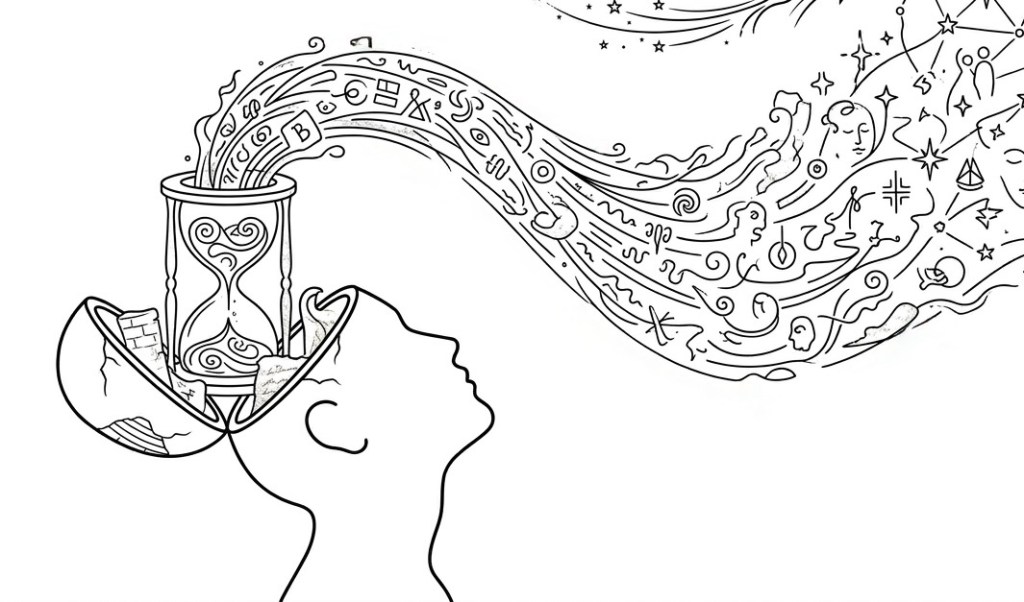
Somewhere on my computer there is an essay called “In the Name of God, Not the Government,” written after a conversation with a friend that began, as these things do, with a small disagreement over tea and ended several hours later in the kind of territory where you are no longer arguing about policy but about what you think God actually wants from political life. The argument I assembled was that Islam functions most authentically as a moral orientation rather than a governing apparatus, and I assembled it with the particular intensity that comes from having just been challenged by someone whose thinking you cannot dismiss. The prose was sharp. The reasoning, I thought, was honest. I believed what I had written, thoroughly and without reservation, in the way that you believe something you have only just finished articulating for the first time.
I did not post it.
In the same folder, untouched for longer than I care to calculate, a set of poems under the title “Remnants.” These were grief poems, written in that period after loss when the writing is not really separate from the mourning itself but continuous with it, another form of the same activity, like sorting through photographs or standing in a room that still smells faintly of someone who is not coming back. They arrived with a kind of necessity that left very little room for editorial judgment. They came because they had to, and at the time that seemed like enough.
I did not post those either.
Then there is a piece on Stirner’s The Ego and Its Own that attempts something I was fairly certain would be refused by most of its potential readers on principle: a serious engagement with a nineteenth-century atheist’s dismantling of reified authority, threaded through nominalism and existentialism and the concept of taghut, bent ultimately toward the claim that Muslims are not obligated to wait for secular states to grant freedoms that God has already authorized. The essay ends with a verse from alBaqarah. It is probably the most genuinely interesting thing I have produced, and also the most exposed, because it positions itself at a crossing point where observant Muslims will see Stirner and recoil and secular readers will encounter the Qur’anic conclusion and lose interest, and neither audience is wrong, exactly, to be suspicious.
Not posted. Along with pages on Kashmir, pages on the nature of authority and who gets to claim it, and several other pieces whose details I will spare but whose fate is identical. All written with conviction, all shelved within weeks of completion, all sitting in the particular silence of a document that has never been opened by anyone other than its author.
What I want to say is that this is about fear, because fear is a legible explanation, one that people understand and even respect in a writer. And there is fear in it. But the thing I have struggled to articulate, even to myself, is that the fear is not primarily of being judged. It is closer to the problem of representation itself, of what it means to fix language to a surface and then walk away from it while it remains.
I returned to the Islam essay roughly five or six months after writing it. I expected, I think, to find the flaws that would retroactively justify the silence, the weak argument or the overreach that would confirm I had been right not to publish. What I found instead was that the arguments were sound. The Qur’anic references held up under rereading. The historical claims were, if anything, more pertinent than when I had first put them together. What had not survived was something harder to name: the urgency, the specific heat of a mind that has just finished thinking something through for the first time and wants, almost physically, to make that thinking visible. That heat had dissipated, not into disagreement but into a kind of ambient assent, the way you might agree with a political position without feeling moved to campaign for it. I still held the views. I no longer inhabited them in the way the prose demanded.
And this, more than any critique of the writing itself, is what stopped me. To publish would have meant lending my name to a register of conviction I was no longer operating at, allowing someone to encounter my prose at its most urgent and mistake that urgency for something I was still actively sustaining. The ideas remained mine, but the relationship between me and those ideas had shifted into something more like custody than passion.
The grief poems raised a different version of the same difficulty. Grief carries its own justification while you are inside it; no one, least of all the person writing, pauses to wonder whether the language is precise enough, because the feeling beneath the language is so unmistakably, almost brutally, present. But six months on, when I could reread “Remnants” without the tightening in my chest that had once accompanied every line, I understood that publishing the collection would stage a grief I was no longer actively experiencing. The poems had already accomplished what they needed to accomplish, privately, in the way that certain writing exists not to communicate but to process. Making them public would not have extended that accomplishment. It would have converted it into something else entirely, a performance of feeling directed at an audience I could not quite imagine and could not quite justify.
The Stirner essay sits in its folder for reasons that overlap with but do not duplicate the others. The passion has not faded in the same way; the argument still interests me. What holds me back is the near-certainty that no single reader will consent to hold both halves of what the piece asks them to hold. The argument requires a willingness to take Stirner’s demolition of abstract authority seriously without extending that demolition to the claims of revelation, and this is a move that demands something of the reader that most readers, reasonably, will not give. Whether that anticipated refusal is a reason to withhold or precisely the reason to publish is a question I have posed to myself repeatedly without arriving anywhere stable.
The pattern, once visible, is difficult to unsee. It is not one essay, not one set of poems, not one difficult argument. It is everything. Every piece of writing I have produced that carried genuine risk, that asked me to stand visibly behind a position I might later want to qualify or abandon, I have kept in a drawer. The collected result is a kind of safety that also functions as a kind of erasure, a bibliography of things I thought and felt and worked through carefully, available to no one, representing nothing.
I am aware of the counterarguments, and I have made several of them to myself with varying degrees of conviction. Writing is inherently provisional. A blog post carries a date, and that date does work, signaling to any honest reader that the thoughts belong to a particular moment rather than to an eternal present. Montaigne, the inevitable reference, built a literary career on the premise that the essay is an attempt, a trial, a sketch that the author might repudiate next week. These are reasonable positions, and in the abstract I find them persuasive. The persuasion weakens considerably when I move from the abstract to the specific, when I stop thinking about provisionality as a concept and start imagining a particular person encountering my particular sentences and constructing from them a version of me that I have already outgrown.
What I keep returning to, without resolution, is that the silence has not actually spared me from misrepresentation. It has only substituted one inaccuracy for another. The essays would have offered an imperfect portrait, a version of my thinking frozen at a moment I had already departed. The silence offers no portrait at all, which is its own distortion, arguably a larger one, because it suggests a person with nothing to say when the truth is closer to the opposite: a person with a great deal to say who has not been able to convince himself that saying it is worth the inevitable divergence between the statement and the self.
I suspect this costs more than I can calculate from inside it. There may be someone who needed the Islam essay, who was working through the same questions about faith and governance alone and would have recognized in my argument, however imperfect, however marked by a particular moment’s heat, something useful. The grief poems might have met a reader at the right hour. The Stirner piece might have provoked exactly the productive discomfort it was designed to provoke. I cannot know any of this, and the impossibility of knowing has made it dangerously easy to behave as though the stakes of silence are zero, when what I actually believe, if I am honest, is that they are simply unquantifiable, which is not the same thing.
I do not have a resolution. What I have is a folder full of writing and a growing awareness that the folder is not the neutral space I once imagined it to be, that keeping the words private has not in any meaningful sense kept me private, that the version of myself I have been protecting from exposure does not hold still long enough to be protected. It is already shifting into the next iteration, the one who will read this essay with a slight and familiar estrangement, recognizing the thinking without quite feeling the feeling, the way you recognize your own handwriting in a notebook from several years ago without being able to reconstruct what you meant by what you wrote.
I am posting this one. Whether I post the next is a question I will leave for whoever I am becoming, who will not, I am fairly certain, feel about it the way I feel about it now.


 Paimana
Leave a comment