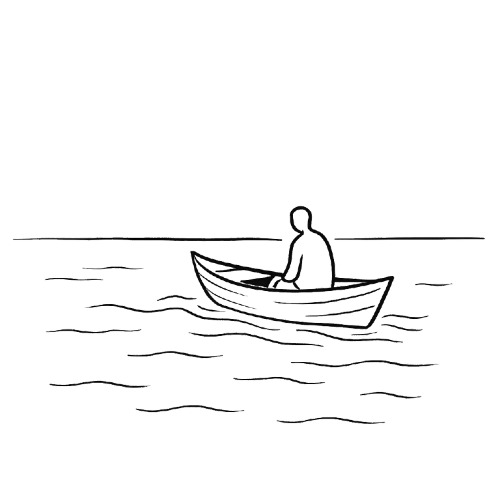
There is an old intuition, passed down by monks, poets, and stubborn skeptics, that truth shows itself most clearly to those willing to be alone. The path to it is not a paved road lit by consensus. It feels more like a foot‑trail through dusk, narrow and irregular, strangely quiet once you leave the village behind. To walk it is to accept the odd companionship of one’s own mind.
Night near Myrtle–Wyckoff. The L exhales and rattles away, and, for a breath, there is a vacuum of sound. I cross the seam where Queens leans into Brooklyn—no signpost, only a shift in brickwork and the angle of the stoops. A pocket notebook rides in my coat. The phone stays on a bookshelf at home, buzzing to no one. Wet iron hangs in the air. A bodega gate drops like a period. I am not out for revelation; I want to hear what my thinking sounds like without the city finishing my sentences. Two lines come to mind; on the empty stairs I mouth them—from Iqbal’s Bang‑e‑Dara:
ہے تری کشتی میں طوفاں کا تلاطم ہر طرف
اور سکوں ساحل سے ہے سامانِ رسوائی ترا
Hai terī kashtī mein tūfāñ kā talātum har taraf,
Aur sukūñ sāhil se hai sāmān‑e‑rusvāʾī terā.
The image is plain. The self is a boat. The storm is the churn of honest questioning. The shore is borrowed calm. Iqbal’s warning is not a romance with danger; it is a warning about the cost of a safety that asks you to leave your own vessel. Peace bought on land can become a quiet kind of self‑betrayal. Only later did I recognize that what felt like doubt was the first practice of attention.
Early on, I mistook inheritance for insight. The truths of my childhood arrived in careful hands, teachings repeated with love, stories offered like heirlooms. I accepted them as one accepts a family keepsake, grateful not to have to make such a thing from scratch. Then hairline fractures appeared. A claim that did not match an experience. A rule that contradicted another rule. The more I looked, the more I saw. None of this was dramatic. Beliefs seldom shatter; they loosen. They slide a little in the palm until, one day, you notice you have been clenching your fist to keep them from slipping away. When I finally opened my hand, what remained was not certainty but a hunger.
When I was younger, at home in a Gulf city, the adults told familiar stories and our nodding arrived on cue. I asked a tidy question, the kind that should not threaten anything, about how a rule met the exception everyone quietly made. The room paused the way rooms do when a coaster is nudged out of alignment. Someone poured tea. The moment closed. Walking down the corridor, I could feel where the story should not be touched. It was not a scandal, only a draft under a closed door. Beliefs did not shatter; they loosened, just enough to show daylight.
Leaving familiar ground did not make me wise; it made me lonely. The social warmth that comes from shared convictions receded. Conversations thinned. I felt, at times, like a person who has stopped humming the chorus and now hears how loud the chorus really is. Yet in that quiet I noticed a new fidelity taking shape, an integrity that does not outsource its conscience. Seeking truth alone meant refusing to rent my judgment from the nearest tribe. It meant building, slowly and often with poor tools, a structure of understanding I could inhabit without apology.
Between places, I measured my twenties in leases and SIM cards, in new time zones and new shorthand for belonging. Each move offered a different chorus to learn, a fresh set of passwords for acceptance. Loneliness taught me that moving does not make you independent; paying attention does.
Others have walked this terrain. Nietzsche wrote about the thinker as a wanderer, exiled by comfort and drawn toward clearer air on higher ground. Socrates paid dearly for preferring hard questions to soft agreement. In the Islamic tradition, al‑Ghazali stepped away from prestige and certainty to test, in solitude, the difference between knowing about and truly knowing. Buddhist and Christian monastics retreated into deserts and forests, not to escape the world but to recalibrate their attention so the world could be seen as it is. Artists and scientists model the same arc: Beethoven sketching themes no one else could yet hear; Marie Curie in a drafty shed boiling pitchblende for months; a programmer working through the night to find an elegant proof of concept. In Shia memory, Musa al‑Kazim is held up for sabr and for kazm—the holding of anger so judgment stays clear—a solitude that is not spectacle but custody of the self. These parallels are imperfect. No life maps onto another. They rhyme in one respect: solitude becomes a workshop, not a hiding place.
The workshop has a cost. Communities often treat certainty as the price of admission. Doubt, especially public doubt, can be read as betrayal or pose. The strain is real. Belonging organizes our days. To risk it for the sake of a better answer can look, even to oneself, like a bad bargain. Social psychologists have long shown how powerfully we conform, even to obviously wrong judgments, when the group points in a single direction. That tug does not vanish when we pronounce ourselves independent. Independence is a muscle. It shakes under weight before it steadies.
Queens, a holiday dinner that runs long. Plates stack by the sink. A game murmurs from another room. A family thread pings across time zones. Someone asks why I do not show up to what I used to show up to. “I am not angry,” I say. “I am trying to be honest.” The air tilts. A joke arrives to lower the temperature. I wash dishes longer than necessary, listening to water drum on the aluminum. It is startling how quickly quiet can form around a person in a crowded apartment. Independence turned out not to be a pose.
Still, solitude is not merely abstaining from company. It is a discipline of attention. Cut off from the constant noise of affirmation and outrage, the mind’s instrument retunes. The background static lowers; faint signals rise. Quiet becomes diagnostic: if an idea cannot survive the silence of a long walk, it likely cannot survive a serious life. In this sense, solitude resembles pressure and time. It compresses and clarifies and sometimes produces something durable because it refuses speed and applause.
Past midnight at my Ridgewood kitchen table. Radiators hiss. The Qarshi Joshanda box sits where it always does, sachets leaned like small envelopes of weather. My mug is ceramic and white. I do not use much color. Or maybe I do, but I have not practiced it yet. I pour half a cup of kettle‑boiled water—no more, since a full cup dampens the taste. The Rotring 600 rests beside a notebook. Board‑prep notes sit open but patient. I write three questions at the top of a clean page: Who benefits if I believe this? What evidence would change my mind? What am I afraid of losing? I let the silence stretch until the first, worse answers tire out. Somewhere in the alley a cat complains on principle. The silence does not agree with me; it confronts me, and I stay long enough to listen.
This stance matters particularly now, when we live inside the machinery of consensus that operates at the speed of a thumb. Feeds compress and corrugate opinion until it arrives as inevitability. It is easy to mistake the most repeated view for the truest one. Solitude counters by reclaiming attention from the market. It asks: Who benefits if I believe this? What evidence would change my mind? What am I afraid of losing if this turns out to be false? The hunger for shore‑peace is strong, but the couplet reminds me that calm borrowed from the shore can become its own disgrace. Better a small boat in honest water than dry land that costs your nerve. These are not questions an algorithm will serve unprompted. They arise in the margin, while reading slowly, while journaling, while sitting without soundtrack long enough for discomfort to have its say.
Yet there is a necessary counterweight. Truth is not only a private epiphany. It is also a public achievement. The sciences are built on solitary hunches tested by communal critique. Art is made in silence and completed in conversation. Even moral insight matures when it collides with lives unlike our own. The philosopher Charles Peirce called this the community of inquiry, the idea that errors get corrected over time by many minds asking the same earnest question. Dialogue does not replace solitude; it refines it. Without others, the solitary seeker risks mistaking the intensity of a feeling for the weight of a fact. Without solitude, the group risks mistaking the momentum of agreement for evidence.
After a small Illuminationist seminar in the city, I end up across the street with a friend who asks better questions than I had asked myself. We cross out a few claims, add “maybe” to others, and sketch two boxes on a napkin to see where the logic actually turns. By the second cup, we have not won. We have built a small scaffolding that can hold our weight for now.
The rhythm that makes sense to me now is alternation: withdraw, return, test, withdraw again. In religious language, this is the pattern of desert and city. In intellectual life, it is research and peer review. In politics, it is conscience and coalition. Each half without the other deforms. Permanent retreat can harden into elitism or fantasy. Permanent immersion can flatten into groupthink or fear. Together they form a kind of epistemic breathing—inhale the world alone; exhale what you think you have learned among others; then listen for the corrections you could not generate by yourself.
Practically, this looks less heroic than the myths suggest. It is a room with a door that closes and a phone left in another room. It is a reading list that crosses boundaries—scripture and satire, memoir and method, voices from traditions you were taught to distrust. It is a notebook where you argue with yourself in ink. It is a handful of people, not many, with whom you can disagree without performing righteousness or cruelty. When you are lucky, it is a mentor who prizes questions over disciples, or a friend who is loyal to your becoming rather than to your comfort.
The work is emotional as much as intellectual. Solitude stings. On some evenings it feels like failure, a sign that you mismanaged your alliances. But loneliness has information embedded in it. It tells you what you value, where you are tempted to drift back to the nearest chorus, and which truths you are not yet ready to carry without external scaffolding. Over time, a different affect takes shape—not triumph, not aloofness, but a steadier patience. You trust your process more than your mood. You resist the melodrama of purity. You let your views be provisional without letting them be careless.
There is also humility here, not as a posture but as a method. If solitude is a crucible, it must burn away borrowed certainties and the hero story in which you alone can see what others cannot. The goal is not to be singular. The goal is to be accurate, or at least less wrong than yesterday. The most reliable sign that solitude is doing its work is not increased distance from people but increased charity toward them. You begin to recognize in others the same scaffolds you once clung to, the same fears, and you become more adept at asking real questions instead of delivering speeches.
When truth does arrive—and it does, even if only in increments—it rarely announces itself with drama. It appears as a small coherence: a sentence that finally fits, an action that aligns with conscience without theatrical effort, a quiet sense that you are no longer arguing internally about what you must do next. These moments are easy to miss because they are not performative. That is part of their reliability. They persist when no one is looking.
Before sunrise, the L slides into Myrtle–Wyckoff. Later, in the residents’ workroom, pre‑round notes open beside a half cup of hot Joshanda. The Rotring 600 waits on the clipboard. I test a sentence under my breath—not a grand thesis, only one clear line I can carry into any room without changing shape at the door. A familiar argument surfaces that afternoon on the floor, and I do not reach for volume or irony. I use the sentence. It holds. What I carry back is not certainty, only a sentence I can live by in public.
I have come to accept that this path will remain, at times, solitary. The ache is part of its texture. But solitude has shifted, for me, from exile to stewardship. It is the space where I can be fully responsible for what I believe and why, the place where I can put down what does not hold and pick up what I am prepared to defend. The village is not my enemy. It is where I bring back what I found, to test it, to revise it, and sometimes to let it go.
Dawn on the same border street where Queens leans into Brooklyn. A bakery pulls trays from the oven. A cyclist ghosts past with yesterday’s headlines strapped to the rack. Rooftops take on a thin rose edge. Nothing about the world has simplified. I do not want the counterfeit peace of the shore. I would rather keep a small boat in honest water and learn to steer. I am walking back toward the day with what I did not have before: not agreement, not approval, but stewardship of my own attention.
In the end, seeking truth alone is not an act of defiance so much as an act of fidelity—to reality, to conscience, to the slow work of becoming a person who can stand in public without being held upright by the crowd. If there is grace in this, it is subtle. If there is strength, it is quiet. But it is enough. Truth does not reward speed or volume. It opens, inch by inch, for those willing to bear the cost of looking, and to bear it again tomorrow.
Wassalam,
Raza


 Paimana
Leave a comment